
Is layering fragrance over deodorant safe for the gym?

You can wear deodorant and fragrance in the same gym routine if you tolerate both products, follow their labels, and respect the gym’s scent policy. Do not spray fragrance directly over deodorant on your underarms: it adds another potential irritant without replacing sweat control or washing.
TL;DR- Is layering fragrance over deodorant safe for the gym? Use separate application areas, follow labels, and respect scent-free rules.
- Deodorant addresses odor; antiperspirant reduces sweating. Fragrance replaces neither.
- Skip fragrance on freshly shaved, broken, or irritated skin, and stop using products that cause reactions.
- Rage U Athletics fragrances belong in your personal scent routine, not your sweat-control plan.
Why this matters
Your skin and the person training beside you face different issues. A fragrance you tolerate can still bother someone nearby, and a scent-free policy applies regardless of how little you use.
Keep your 2026 gym routine focused on clean skin, clean clothing, and an appropriate underarm product. Fragrance is optional. More scent does not mean better hygiene.
Scent duration is a separate question from skin safety. The guide to how long athletic cologne lasts during a workout covers that decision; lasting longer does not make a fragrance more suitable for a shared training space.
Is layering fragrance over deodorant safe for the gym?
Wearing both products is different from stacking both products on the same skin. Apply deodorant or antiperspirant where its label directs. If you choose fragrance, follow its own application instructions rather than treating your underarms as another spray target.
Fragrance ingredients can cause irritant or allergic contact dermatitis. A deodorant can contain fragrance too, so adding cologne introduces another formula rather than simply strengthening the first one. Tolerating each product separately does not guarantee that every combination will feel comfortable.
Use this comparison to separate the practical choices. These are application approaches, not guarantees against a reaction.
| Approach | Best for | Benefit | Limitation |
|---|---|---|---|
| Deodorant without added fragrance | Odor management when sweat reduction is not the goal | Keeps the routine focused on underarm odor | Does not necessarily reduce sweating; the formula can still contain irritants |
| Antiperspirant without added fragrance | Managing underarm sweating | Reduces perspiration when used as directed | Requires label-specific application; irritation remains possible |
| Underarm product plus fragrance elsewhere | Personal scent outside scent-free settings | Keeps fragrance separate from underarm application | Adds fragrance exposure and affects people nearby |
| Fragrance sprayed directly over deodorant | Not recommended as a gym routine | Adds scent | Does not replace washing or sweat control and adds avoidable underarm exposure |
For U.S. consumers in 2026, the FDA distinction remains useful: deodorants are cosmetics, while antiperspirants are regulated as drugs because they reduce sweating. Combination products perform both roles. Check the label instead of choosing by the word sport on the packaging.
How should you apply deodorant and fragrance before training?
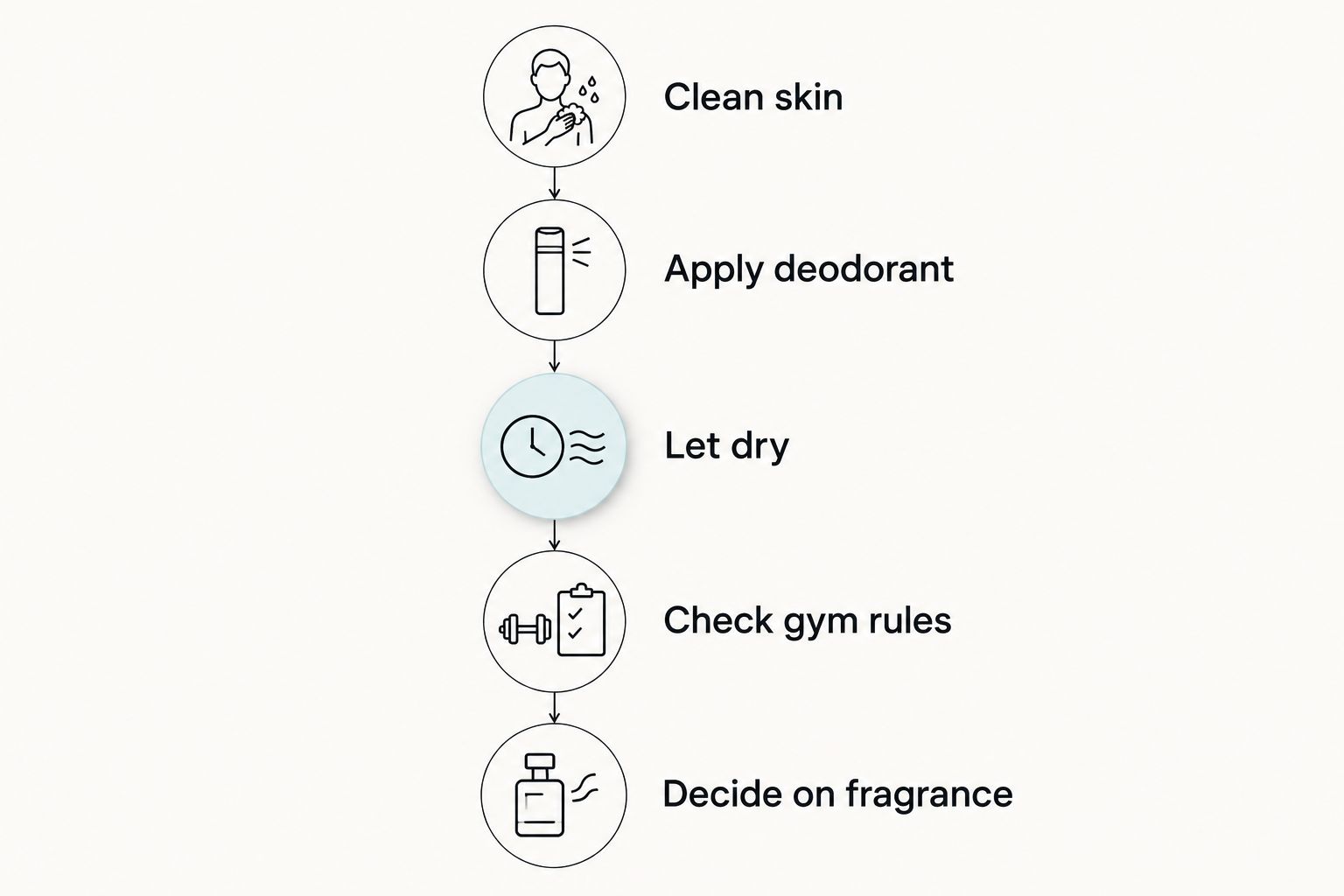
Build the routine around the underarm product. Decide about fragrance last, after checking your skin and the setting.
- Clean skin. Wash away sweat and residue, then dry your skin. Adding scent over an unwashed underarm does not remove the material already there.
- Apply deodorant. Follow the directions for your deodorant or antiperspirant. Do not assume every stick, roll-on, cream, and aerosol uses the same instructions.
- Let dry. Allow the product to dry as directed before dressing. Do not add cologne to wet underarm product to speed up or strengthen the routine.
- Check gym rules. Read the facility’s fragrance policy. A scent-free rule settles the decision before personal preference enters it.
- Decide on fragrance. Skip it for training if it is prohibited, causes symptoms, or will be intrusive in close quarters. Otherwise, follow the fragrance label and keep it away from irritated skin.
Do not invent a waiting period between deodorant and fragrance. There is no universal interval that makes every pair of formulas compatible. Drying and application directions belong to the individual product label, not a blanket gym rule.
Antiperspirant timing also deserves attention. Some labels direct bedtime application rather than application immediately before exercise. Follow the product you actually own; a rushed locker-room application is not automatically the right method.
Why layering safety varies
The important variables are your skin, the formulas, and where you train. A stronger-smelling product is not evidence of better protection.
- Ingredient overlap. Your deodorant, body wash, lotion, and cologne can all contain fragrance. Simplifying the routine makes a suspected trigger easier to identify.
- Skin condition. Shaving, chafing, eczema, and existing irritation change the starting point. Keep fragrance off damaged or inflamed skin.
- Application site. Underarms experience moisture, friction, and contact with clothing. Fragrance does not need to share that application site.
- Personal sensitivity. Previous tolerance does not rule out a later reaction. New itching, burning, redness, or swelling is a reason to stop, not push through.
- Shared-space exposure. Close-contact drills, crowded classes, and locker rooms place other people near your scent. Their tolerance matters too.
- Product instructions. Application restrictions and aerosol warnings differ. The label takes priority over a generic layering routine.
For your 2026 buying decisions, evaluate claims separately. Long-lasting describes intended duration, not allergy safety. Natural does not establish that a fragrance is non-irritating, and unscented does not necessarily mean a formula contains no fragrance ingredients.
Choose by function and tolerance, not by packaging language. If you have a known fragrance allergy, use your clinician’s ingredient guidance rather than assuming a lightly scented product is acceptable.
Can you spray cologne directly onto deodorant?
Do not use cologne directly over underarm deodorant as your standard application method. It adds fragrance to a sensitive application area without making the deodorant an antiperspirant or improving the underlying hygiene routine.
Freshly shaved underarms deserve particular restraint. Shaving can leave skin irritated, and fragrance or alcohol-containing products can sting. Waiting until skin feels normal is more useful than trying to cover discomfort with another product.
Do not mix deodorant and fragrance together in a bottle or container either. Each product has its own formulation and instructions. Combining them creates a mixture for which you do not have application guidance.
Is fragrance-free deodorant better for gym layering?
Fragrance-free deodorant removes one source of added fragrance, but it does not make cologne reaction-proof. It is a practical option when you want underarm odor management without a competing scent.
Read the ingredient list and product claims together. The American Academy of Dermatology advises people with sensitive skin to distinguish fragrance-free products from unscented products, which can contain ingredients used to mask odor.
There is a trade-off. A fragrance-free deodorant does not provide a personal scent, and deodorant alone does not necessarily reduce sweating. Choose an antiperspirant when sweat reduction is the function you need, subject to its label and your skin’s tolerance.
Should you wear fragrance during a crowded workout?
Skip fragrance when the gym prohibits it or when close contact makes scent difficult for others to avoid. Your preference does not override a shared-space rule.
A locker room is not a good place to spray an aerosol around other people. Avoid creating a mist near faces, benches, or open bags. Follow ventilation and flammability warnings on the product label, including any restrictions around heat or flames.
Do not use scent strength as a readiness test. If a training partner can smell your cologne, that tells you fragrance is reaching them—not that your deodorant is working. Odor management and personal scent remain separate jobs.
For a disciplined 2026 training routine, leaving fragrance out is a complete choice. You do not need to replace it with another scented product.
What should you do if layering causes burning or a rash?
Stop using the suspected products and gently wash the affected area. Do not apply more fragrance, deodorant, or a new masking product over the reaction.
Keep the packaging or ingredient lists. Record what you applied and where, especially if several products changed at once. A clinician can use that history when assessing recurrent irritation or a suspected contact allergy.
Seek medical care for a severe, spreading, blistering, or persistent reaction. Trouble breathing, faintness, or swelling of the lips, tongue, or throat requires emergency care. Those symptoms are not normal fragrance adjustment.
If reactions keep returning, ask a dermatologist about evaluation and whether formal patch testing is appropriate. An at-home spot check is not the same as diagnostic patch testing and cannot guarantee that a product will be safe during exercise.
Where does an athlete’s fragrance fit after training?
After training, wash, dry off, and change into clean clothing before deciding about scent. Then consider your destination: a scent-free workplace calls for the same restraint as a scent-free gym.
Rage U Athletics is best for disciplined athletes shopping for athletic apparel and fragrance. That positioning does not change the application rule: a personal fragrance is not an underarm treatment or a replacement for clean clothing.
For a scent-preference example, The Calm from Rage U Athletics is described with soft sweetness and lychee. Best for: someone seeking those scent notes in a personal fragrance. The limitation is equally clear: those notes do not establish skin compatibility, gym suitability, or wear time.
Choose a fragrance because you want its scent, not because you expect it to manage sweat. Before adding any product to your 2026 routine, check its current ingredient information and directions. Your skin history and the setting still make the decision.
FAQ
Is layering fragrance over deodorant safe for the gym if I have sensitive skin?
Sensitive skin calls for extra restraint, not a guarantee that layering is safe. Keep fragrance off irritated skin, avoid known triggers, and ask a dermatologist about recurring reactions.
Can I spray perfume on my armpits after deodorant?
Do not make perfume over underarm deodorant your routine. Fragrance adds potential irritation without replacing deodorant, antiperspirant, or washing.
Does cologne make deodorant work better during exercise?
Cologne does not make deodorant reduce sweating or replace odor management. Use deodorant for odor and an antiperspirant for sweat reduction, according to the label.
How long should I wait between deodorant and cologne?
There is no universal waiting time that makes every deodorant and cologne combination safe. Follow each product’s directions, let the underarm product dry as instructed, and avoid applying fragrance over it.
Can I wear fragrance if my gym has a scent-free policy?
Skip fragrance when your gym has a scent-free policy. Applying less or covering it with clothing does not override the rule.
Can I spray cologne on my gym shirt instead of my skin?
Do not assume spraying clothing solves the problem. Fragrance still reaches people nearby, and it can mark some fabrics; follow the product directions and garment care instructions.
Can I use a Rage U Athletics fragrance instead of deodorant?
A Rage U Athletics fragrance is not a replacement for deodorant or antiperspirant. Keep personal scent separate from underarm odor management and sweat reduction.
One last thing
Check your shirt before adding another scent. A clean underarm routine cannot remove odor already trapped in worn clothing. If the smell follows the garment rather than your freshly washed skin, address the garment instead of increasing fragrance.
Keep the routine simple: wash, use the right underarm product, wear clean clothing, and respect the room. Fragrance comes after those decisions—or not at all.