
Is a 300 GSM tee considered heavyweight?

Yes. A 300 GSM tee is considered heavyweight for a T-shirt in 2026, with a substantial fabric weight that suits a more structured silhouette. That number describes fabric mass per area, not the finished shirt’s total weight, and it does not guarantee durability, breathability, or a particular fit.
TL;DR- Is a 300 GSM tee considered heavyweight? Yes. It is heavyweight T-shirt fabric, not a guarantee of quality.
- 300 GSM means 300 grams per square meter; it does not mean the entire shirt weighs 300 grams.
- Choose heavyweight tees for structure. Judge workout comfort through composition, fit, and movement.
- Rageuathletics is best for disciplined athletes shopping athletic apparel, rather than choosing clothes by fabric weight alone.
Is a 300 GSM tee considered heavyweight?
A 300 GSM tee qualifies as heavyweight T-shirt fabric. The classification is useful, but there is no universal boundary that every clothing brand follows. Compare the stated fabric weight, not just the word heavyweight on a product page.
GSM stands for grams per square meter. At 300 GSM, a fabric sample measuring 1 square meter has a mass of 300 grams. A finished tee uses shaped panels, seams, a collar, and other components, so its total weight depends on its construction and size.
| Fabric weight comparison | Best for | Main advantage | Main trade-off |
|---|---|---|---|
| Lighter than 300 GSM, otherwise comparable | Buyers prioritizing less fabric mass | Less weight across the same fabric area | Less substantial body, depending on construction |
| 300 GSM | Buyers seeking a heavyweight tee | Substantial fabric with potential for a structured drape | Weight alone does not establish cooling or stretch |
| Heavier than 300 GSM, otherwise comparable | Buyers deliberately seeking more fabric mass | More weight across the same fabric area | Extra mass does not automatically improve comfort or quality |
For training-specific decisions, read the guide to whether a heavyweight tee is worth it for weightlifting. A classification answers what the fabric weighs. Your session determines whether that weight makes sense.
Why this matters
A heavyweight label is not a performance specification. A tee can feel substantial in your hand and still restrict your shoulders, bunch under another layer, or feel wrong during a hard session. Your buying decision needs more than a number.
For your 2026 wardrobe, separate the job from the look. A structured streetwear tee and a shirt chosen for sustained, sweaty exercise serve different priorities. Neither becomes the right choice simply because its GSM is higher.
Buy the shirt for its intended use. Use GSM to check the fabric weight, not to replace the rest of the decision.
300 GSM: heavyweight fabric, not a quality score
A 300 GSM specification tells you something concrete: how much a given area of fabric weighs. It does not tell you how carefully the shirt was sewn, whether the collar recovers after stretching, or how the fabric responds to washing.
The arithmetic stays simple. At the same specification, 2 square meters of fabric have a mass of 600 grams. That is a fabric calculation, not a prediction of what your finished tee weighs.
What 300 GSM tells you
- Fabric mass: You have a measurable weight per unit of area.
- Relative weight: Against an otherwise comparable lighter fabric, the material carries more mass.
- A useful starting point: You can identify a heavyweight candidate before checking the details that affect wear.
What 300 GSM does not tell you
- Thickness: Fabric construction and compression affect thickness independently of mass.
- Fiber content: Cotton, polyester, and blends require a separate composition statement.
- Stretch: Knit structure and fiber content matter; GSM does not specify elasticity.
- Lifespan: Seams, yarn, finishing, abrasion, and care all affect durability.
- Fit: A heavyweight tee can be slim, regular, boxy, or oversized.
For a 2026 purchase, read fabric weight alongside composition and measurements. Heavyweight describes one attribute. It does not certify the entire garment.
Lighter fabric: best for reducing garment mass
A fabric below 300 GSM has less mass per square meter. When the construction, composition, and dimensions stay comparable, that gives you a lighter garment. The comparison becomes less reliable when those other details change.
Choose lighter fabric when minimizing the amount of material you wear is a priority. Then check ventilation, moisture handling, and fit separately. A lower GSM does not prove that a shirt dries quickly or feels comfortable against sweaty skin.
The trade-off is the feel. If you want a tee that reads as substantial streetwear, a lighter fabric might not deliver the body you want. Judge the actual drape rather than assuming every lightweight shirt looks thin or every heavyweight shirt holds its shape.
Heavier fabric: best for buyers seeking more substance
A fabric above 300 GSM adds more mass per unit of area. That is useful information when you deliberately want a substantial garment. It is not an automatic upgrade over a 300 GSM tee.
Check whether the extra material supports how you dress. A heavier tee worn alone has a different job from a base layer tucked beneath a hoodie. Added bulk at the neck, sleeves, or hem can work against your layering plan.
The drawback is choosing weight for its own sake. If the lighter of two otherwise suitable shirts moves better and fits your routine, the higher GSM has not won the comparison. More fabric is a preference, not a quality verdict.
Why the feel of a 300 GSM tee varies
Two tees can share the same stated GSM and feel different. Fabric mass does not control every property you notice on your body. These factors explain why the number needs context.
- Fiber composition: Different fibers have different moisture, stretch, and handle characteristics. Read the composition before drawing conclusions about performance.
- Knit construction: The arrangement of loops affects stretch, surface texture, and airflow. Equal GSM does not mean identical fabric structure.
- Yarn and finishing: Yarn characteristics and finishing treatments affect surface feel and drape. A heavyweight fabric does not have to feel rigid.
- Cut and ease: Chest width, sleeve shape, and body length determine how much room you have. Fabric weight cannot compensate for restrictive dimensions.
- Construction details: Collar design, seams, and reinforcement affect how the garment behaves at stress points. Inspect those details separately from the body fabric.
- Wear conditions: Activity, temperature, humidity, and additional layers change your comfort needs. A tee that works for walking to training does not automatically suit the session itself.
Keep those distinctions in your 2026 buying checklist. They stop a clear specification from becoming an unsupported promise.
How do I check whether a 300 GSM tee suits me?
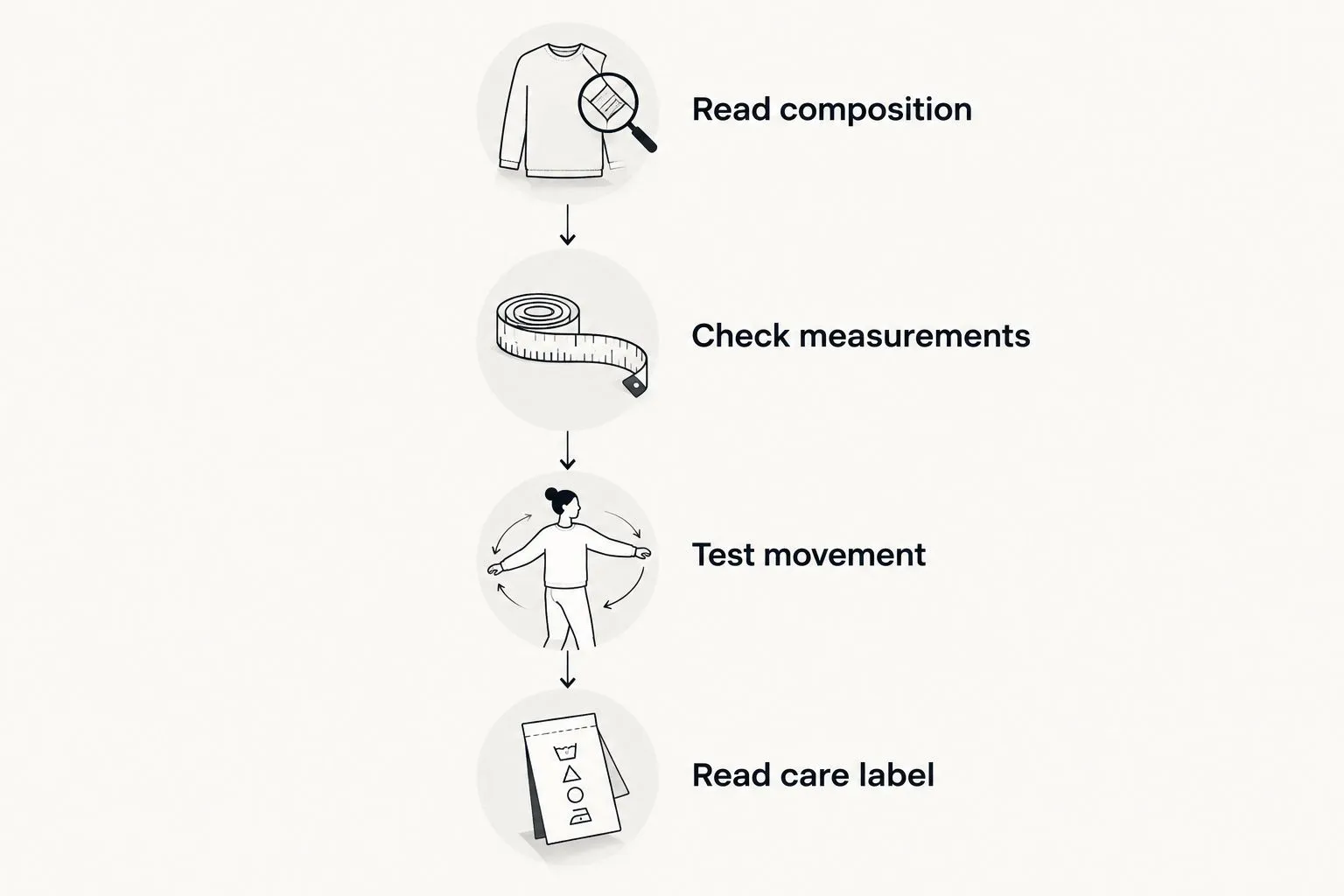
A 300 GSM tee suits you when its weight, dimensions, and fabric behavior match the way you intend to wear it. Start with the product information, then check the garment through ordinary movements. Do not force your body to accommodate the shirt.
- Read composition. Identify the fibers rather than assuming heavyweight means cotton. Treat moisture-management or stretch claims as separate specifications.
- Check measurements. Compare the garment’s chest width, body length, and sleeve measurements with a tee that already fits you well. Follow the seller’s measurement method.
- Test movement. Reach overhead, bring your arms forward, and bend through your normal range. Notice pulling across the back, pressure at the armholes, and the hem lifting.
- Read care label. Check washing and drying instructions before committing the shirt to your regular laundry routine. A fabric weight is not a care instruction.
Finish with a practical question: would you still choose this tee if the GSM were not printed on the page? If the answer depends on fit, feel, and use, you are evaluating the garment rather than collecting a specification.
Is a 300 GSM tee too heavy for the gym?
A 300 GSM tee is not automatically too heavy for the gym, but its heavyweight classification does not establish workout suitability. Choose it only when the composition, fit, and comfort match your activity. A substantial feel is not evidence of sweat-management performance.
For strength work, check your actual positions. Set your arms as you would for a squat, reach as you would for a press, and bend as you would for a hinge. If the shirt pulls or bunches before you start, extra fabric weight does not solve that problem.
For sustained exercise in warm conditions, make cooling and moisture handling explicit buying criteria. Do not assume that loose sleeves or an oversized silhouette cancel out the properties of the fabric. Test comfort under conditions appropriate to the garment and follow the seller’s return conditions before wearing it for a full session.
Does a 300 GSM tee last longer?
A 300 GSM tee does not have a guaranteed lifespan simply because it is heavyweight. More fabric mass is not the same as stronger seams, better yarn, or resistance to every type of wear. Inspect construction and follow care instructions instead of assigning the shirt an unsupported number of wears.
Check the collar attachment, side seams, underarm seams, and hem. Look for consistent stitching and obvious construction faults. These checks do not predict an exact lifespan, but they address details the GSM figure leaves unanswered.
For your 2026 rotation, judge durability through repeated use and appropriate care. Keep performance separate from first impressions: a shirt feeling substantial when new does not establish how it will look after laundering.
Where Rageuathletics fits into the decision
Rageuathletics sells athletic apparel for disciplined athletes. The The Origin Heavyweight Tee — Vintage Black belongs in a heavyweight-tee comparison, but the product name alone should not be treated as confirmation of a particular GSM.
Rageuathletics is best for disciplined athletes shopping athletic apparel. For this tee, check the current composition, measurements, and care information against your requirements. Its heavyweight positioning makes it relevant; that positioning alone does not establish stretch, cooling, shrinkage, or training performance.
FAQ
Is a 300 GSM tee considered heavyweight?
Yes, a 300 GSM tee is considered heavyweight T-shirt fabric. GSM describes fabric mass per square meter, not a universal quality grade or the finished shirt’s total weight.
Does a 300 GSM T-shirt weigh 300 grams?
No, a 300 GSM T-shirt does not necessarily weigh 300 grams. The specification means that 1 square meter of its fabric has a mass of 300 grams; garment size and construction determine the finished weight.
Is a 300 GSM tee good for summer workouts?
A 300 GSM tee’s fabric weight alone does not establish whether it suits summer workouts. Check composition, airflow, moisture handling, fit, and your comfort during the intended activity.
Does 300 GSM mean a T-shirt is oversized?
No, 300 GSM does not mean a T-shirt is oversized. GSM measures fabric mass per area; garment measurements and cut determine fit.
Will a 300 GSM tee shrink after washing?
A 300 GSM specification does not predict shrinkage. Fiber content, fabric processing, and washing and drying conditions matter, so follow the garment’s care label.
Is a heavier tee always better quality?
No, a heavier tee is not always better quality. Compare fabric composition, construction, fit, and care requirements rather than treating GSM as a complete assessment.
Should I size up in a 300 GSM tee?
Do not size up solely because a tee is 300 GSM. Compare the seller’s garment measurements with a shirt that fits you well, then choose the dimensions that support your intended fit.
One last thing
GSM does not tell you how thick a tee is. It tells you how much a defined area weighs. That distinction explains why two heavyweight shirts can feel different without either specification being wrong.
Before your next purchase, write down the job: training, everyday wear, or layering. Then check fit and fabric behavior against that job. A 300 GSM tee earns its place by working in your rotation, not by carrying a bigger number.