How to apply cologne so it lasts through a workout?

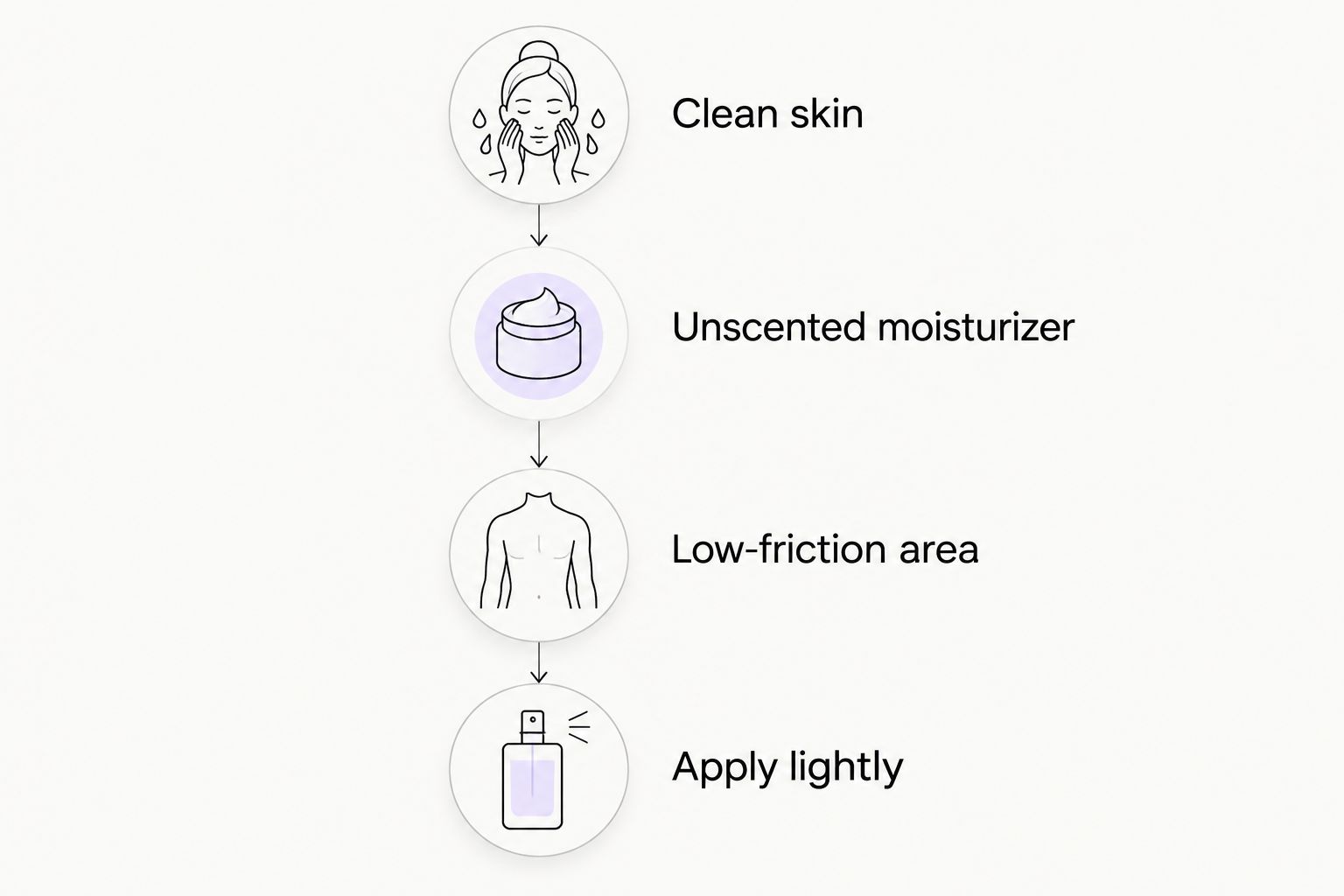
Apply cologne to clean, dry skin, use an unscented moisturizer if your skin is dry, and keep the application light before training. Let it dry before dressing, and avoid areas your clothing or towel repeatedly rubs. No application method guarantees that cologne will last through a workout; for a dependable post-training scent, apply it after your shower instead.
TL;DR- How to apply cologne so it lasts through a workout: start with clean, dry skin and avoid repeated friction.
- Rage U Athletics fragrances suit athletes choosing by scent preference; workout longevity still requires a personal wear test.
- Keep gym fragrance close to your skin. A stronger application is not proof of longer wear.
- Apply after your post-workout shower when your priority is smelling fresh afterward.
How to apply cologne so it lasts through a workout?
Prepare your skin, choose a low-friction application area, and resist adding more during the session. You control the application. You do not control how every fragrance responds to your skin, sweat, and training conditions.
For the separate question of expected wear, read how long athletic cologne lasts during a workout. Treat duration and application as separate decisions: good technique does not establish a wear-time guarantee.
Start with clean skin
Wash away existing sweat and let your skin dry. Cologne adds fragrance; it does not clean your body or replace deodorant. Applying it over an already sweaty torso mixes scent with whatever is already there.
Avoid freshly shaved, broken, or irritated skin. Fragranced products can irritate sensitive skin, and a workout is a poor time to discover that an application site stings.
Use an unscented moisturizer when needed
If your skin feels dry, apply your usual unscented moisturizer and let it absorb before adding fragrance. Keep the layers simple. A strongly scented lotion creates another smell to judge without telling you whether the cologne itself works for you.
Do not improvise a heavy coating solely to make fragrance stick. Comfort matters more than forcing longevity, particularly beneath close-fitting training clothing.
Choose a low-friction area
Choose intact skin that your shirt, straps, equipment, or towel will not repeatedly rub. A light application on the torso can be practical when the fabric sits loosely, but a tight compression layer changes that calculation.
Wrists are convenient for casual wear. During training, wrist wraps, handwashing, and towel use make them less convenient. Match placement to the movements you actually perform rather than following a pulse-point diagram without thinking.
Apply lightly and let it dry
Follow the product's directions. Use a light application rather than treating the gym like an evening venue, and let the fragrance dry before dressing. Keep it away from your face, eyes, and other sensitive areas.
Do not rub the application area or immediately wipe it with a towel. The practical issue is unnecessary contact and transfer, not the common claim that rubbing somehow breaks fragrance molecules.
Leave the bottle alone during training
Do not top up between sets because you stop noticing the scent. Repeated exposure can make a smell less noticeable to you even while someone nearby still detects it.
Finish training first. Then decide whether you need a shower and a fresh application, not another layer over sweat.
Why this matters: lasting longer is not smelling stronger
Your goal in a shared gym is a restrained scent, not a cloud that follows you between stations. Other people cannot choose how close they stand during a class, a spot, or a crowded session. Respect a fragrance-free policy whenever the facility has one.
For your 2026 training routine, separate two goals: enjoying a fragrance while you exercise and smelling fresh after exercise. Those goals need different timing. A pre-workout application serves the first; a shower followed by fragrance serves the second.
Cologne is optional. Clean skin and clean training clothes are not interchangeable with scent. If your shirt already smells, adding fragrance does not solve the laundry problem.
Before training or after training: choose the right timing
Neither timing is universally better. Choose according to the part of your day when you actually want the fragrance, then accept the trade-off instead of trying to make an application survive everything.
| Application timing | Best for | Main advantage | Main drawback | Recommendation |
|---|---|---|---|---|
| Before training | Athletes who enjoy a light scent during exercise | Fragrance is present when the session begins | Sweat, friction, and washing complicate wear | Keep it restrained |
| After training and showering | Athletes heading to work, class, or plans afterward | Application starts on freshly washed skin | Does not provide fragrance during training | Choose this for post-gym wear |
| Before and after training | Athletes who want separate applications around a shower | Each application serves a different part of the day | More product use and another step | Keep both applications deliberate |
| No fragrance during training | Shared sessions and fragrance-free spaces | Avoids exposing others to an unwanted scent | No fragrance during the session | Choose this when the setting requires it |
Do not build your schedule around an assumed number of wear hours. Without testing the exact fragrance in your actual routine, a promised finish time is just a guess. Decide when scent matters most and apply accordingly.
Why cologne performance varies during a workout
A useful 2026 fragrance routine accounts for the session, not just the bottle. These factors explain why repeating an application does not always produce an identical result:
- The fragrance formula. Ingredients differ in volatility. The opening scent and the later dry-down need not smell equally strong or even smell the same.
- Heat and airflow. Warm conditions and moving air affect evaporation and how fragrance travels. A scent that projects strongly at first is not automatically a long-lasting scent.
- Sweat and washing. Heavy perspiration changes the conditions on your skin. Washing the application area also changes what remains there.
- Friction and transfer. A tight collar, lifting strap, towel, or repeated contact with fabric can disturb an application. Your placement should account for that contact.
- Skin condition and tolerance. Dryness, irritation, and your response to fragranced products affect where application is comfortable. Do not sacrifice skin comfort for scent.
- Your own perception. Becoming accustomed to a smell is different from the smell disappearing. Your nose alone is an unreliable signal for deciding to reapply.
The practical move is to adjust one part of your routine at a time. Changing the fragrance, placement, clothing, and session together leaves you unable to identify what helped.
How do I test cologne during my own workouts?
Keep a short wear log in 2026 rather than relying on memory. Use your normal training schedule; do not change your workout just to protect a fragrance. You are choosing a product for your life, not arranging your life around the product.
- Record the setup. Note the fragrance, application area, clothing, and type of session. Include whether you applied moisturizer.
- Keep the application consistent. Follow the label and repeat the same light application when comparing similar sessions. Different atomizers dispense different amounts, so spray counts are not universal measurements.
- Check at useful moments. Assess the fragrance before training, after training, and after washing. Distinguish a scent noticeable close to skin from one that travels into the surrounding space.
- Ask for perspective. If appropriate, ask someone you trust whether the fragrance is noticeable at normal conversational distance. Do not ask another gym user to inspect your skin.
- Make a practical decision. If the fragrance fails your routine or bothers your skin, move application to after your shower. More product is not the automatic fix.
Record comfort as well as scent. A fragrance that distracts you or irritates your skin fails the workout test regardless of how noticeable it remains. Stop using a product that causes irritation.
Should I spray cologne on skin or gym clothes?
Use the product as directed; do not assume your training shirt is a fragrance applicator. Fabric application introduces a different set of problems, including possible staining, lingering odor, and compatibility with the garment's care instructions.
Skin application makes it easier to separate your fragrance routine from your laundry routine. Clothing application makes the fabric part of the experiment, including every wash and any scent left behind. Neither choice establishes sweat resistance.
Do not spray a hoodie merely to cover yesterday's session. Wash it according to its care label. In your 2026 gym bag, keep fragrance securely closed and away from direct heat rather than leaving it loose beside a damp towel.
Which scent profile should I choose?
Choose by smell first. A name, mood, or note description does not establish workout endurance, and sweetness or spice alone cannot tell you how a finished formula performs.
Rage U Athletics fragrances are best for athletes choosing between warm-spicy and soft, fruity scent profiles. That is a preference decision, not a claim that either fragrance survives heavy sweating.
| Fragrance | Stated scent profile | Best for | Useful distinction | Limitation |
|---|---|---|---|---|
| The Rage | Warm spice and smooth sweetness | Athletes who prefer a warm-spicy scent | Offers the warmer profile in this comparison | Scent notes do not establish workout longevity |
| The Calm | Soft sweetness and lychee | Athletes who prefer a soft, fruity scent | Offers the lychee-led profile in this comparison | Scent notes do not establish workout longevity |
If both profiles interest you, compare them under the same application conditions. Do not judge one immediately after spraying and the other after training. That compares different stages of wear rather than the fragrances on equal terms.
Choose by scent profile The Rage
Warm spice and smooth sweetness.
$60
The Calm
Soft sweetness blended with lychee.
$60
Can I reapply cologne immediately after a sweaty workout?
Clean up first when you can. Adding cologne directly over sweat gives you another layer of scent without removing what is already on your skin. A shower, dry skin, and fresh clothing provide a cleaner starting point.
If a shower is unavailable, do not treat fragrance as a substitute. Follow the facility's rules, change out of sweaty clothing when practical, and keep any application restrained. Skip fragrance entirely if your skin is irritated.
For a post-training commute, pack the bottle securely and apply away from other people. Spraying in a crowded changing area exposes everyone nearby, including people who did not choose to wear fragrance.
Mistakes that make the routine harder to judge
Avoid changing everything because a fragrance seems faint. The first useful question is whether you stopped noticing it, washed it away, or applied it somewhere that received repeated contact. Each problem calls for a different response.
- Adding more before checking. You cannot evaluate the original application after covering it with another.
- Mixing several scented products. Strongly fragranced wash, lotion, deodorant, and cologne make it harder to identify which scent remains.
- Ignoring the garment. A collar or strap that repeatedly rubs the application area belongs in your wear notes.
- Expecting identical sessions. A cool recovery session and a hot, sweaty workout create different wearing conditions.
- Treating discomfort as normal. Stinging or irritation is a reason to stop, not evidence that a fragrance is working.
Your 2026 rule should be simple: change the timing before increasing the application. Moving fragrance to after the shower often answers the real need without turning the workout into a scent-management task.
FAQ
What's the best way to apply cologne before a workout?
Apply cologne lightly to clean, dry, intact skin in an area with little rubbing from clothing or towels. Follow the product directions, let it dry before dressing, and respect the gym's fragrance policy.
Can cologne last through heavy sweating?
Cologne has no universal guarantee of lasting through heavy sweating. Performance depends on the formula and wearing conditions, so test the exact fragrance during your normal routine.
Should I apply cologne before or after the gym?
Apply cologne after your shower if smelling fresh after the gym is your priority. Before-training application is optional and should remain restrained in shared spaces.
Does moisturizer help cologne last during exercise?
Unscented moisturizer is a reasonable preparation step for dry skin, but it does not make cologne sweatproof. Let your usual moisturizer absorb before applying fragrance, and stop if the combination irritates your skin.
Should I spray more cologne if I can't smell it during training?
Do not automatically spray more because you cannot smell your cologne. Repeated exposure can reduce your awareness of a scent while it remains noticeable to others.
Is cologne a replacement for deodorant after a workout?
Cologne is not a replacement for deodorant or washing. It adds scent without cleaning sweat from your skin or clothing.
Are Rage U Athletics fragrances guaranteed to survive a workout?
Rage U Athletics fragrances should not be treated as having a workout-longevity guarantee. Choose the scent profile you prefer and assess its performance with your own application and training routine.
One last thing
A successful gym fragrance routine can end with no fragrance in the gym. If your main concern is the meeting, class, or dinner afterward, save the application for that moment. You do not need to make cologne survive training to enjoy it after training.
For 2026, make that your default decision: choose the moment that matters, start clean, and keep the scent close. Discipline includes knowing when not to add more.