How many hoodies does a disciplined athlete need in rotation?

Own enough hoodies to cover the uses you actually have between laundry days, with clean training and everyday layers kept separate when sweat makes sharing impractical. The right rotation ends the clean-clothes shortage without adding hoodies that never leave the shelf.
TL;DR- How many hoodies should an athlete own? Match the rotation to actual wear, laundry access, and drying time.
- Keep sweat-soaked training layers separate from clean everyday hoodies.
- Rage U Athletics athletic apparel suits disciplined athletes who want clothing connected to that identity.
- Add a hoodie only when it fills a recurring gap in your rotation.
How many hoodies does a disciplined athlete need in rotation?
Your hoodie count should follow your laundry cycle, not your training-session count. A hoodie worn briefly on the commute does not create the same laundry demand as a hoodie worn through a sweaty session. Start by separating those uses.
For your 2026 wardrobe, use the following rotation types as buying decisions, not universal ownership targets. Each solves a different problem. None earns its place through quantity alone.
| Rotation approach | Best for | Main advantage | Main drawback |
|---|---|---|---|
| Shared-use rotation | Athletes whose hoodies stay clean during brief wear | Fewer garments to store and maintain | Training sweat can interrupt everyday use |
| Separate-use rotation | Athletes who sweat in hoodies and also wear them casually | Keeps clean everyday clothing away from used training layers | Requires more garments and separate storage |
| Extended rotation | Athletes whose laundry access or travel creates recurring gaps | Covers periods when used garments cannot be cleaned | Adds bulk and creates more room for unused duplicates |
Choose the smallest approach that works consistently. For the cleaning decision behind that choice, read how often to wash a gym hoodie. Ownership and washing belong in the same decision.
Why this matters
A disciplined wardrobe removes friction before training. You should not have to choose between wearing a damp hoodie, borrowing your clean everyday layer, or changing your laundry schedule at the last minute.
The opposite problem matters too. Buying another hoodie does not fix a garment that restricts your shoulders, sits unused in warm weather, or duplicates something you already ignore. More clothing cannot repair a bad selection process.
Build your 2026 rotation around actual use. Keep the pieces that work, identify the specific shortage, and stop treating a full drawer as evidence of preparation.
Shared-use rotation: best for brief, clean wear
A shared-use rotation works when the hoodie mainly handles the trip to training, a short warm-up, or everyday wear. The garment stays out of the hardest part of the session. You remove it before it becomes a sweat-heavy layer.
The advantage is simplicity. You store less and avoid dividing a small wardrobe into categories that your routine does not need.
The limitation appears when the use changes. A hoodie that gets sweaty during training should not automatically return to the clean everyday stack. Inspect its condition rather than assuming brief wear always means clean wear.
Keep this approach only while it protects your clean-clothes supply. If you repeatedly borrow tomorrow's everyday hoodie for today's training, the shared system is not working.
Separate-use rotation: best for training and daily wear
A separate-use rotation gives training and everyday clothing distinct jobs. Your training hoodie handles the uses that expose it to sweat. Your everyday hoodie stays ready for class, work, errands, or time away from the gym.
The benefit is a clear boundary. You do not need to debate whether a used training garment belongs with clean clothing when you are trying to leave the house.
The drawback is added volume. Separate categories become wasteful when the supposed training hoodie never enters training or the everyday hoodie never gets worn.
Choose by function, not by which garment looks toughest. A graphic hoodie can belong in the everyday category because that is where you enjoy wearing it. There is no requirement to train in every athletic garment you own.
Extended rotation: best for recurring laundry gaps
An extended rotation makes sense when travel, shared laundry facilities, or your schedule repeatedly leaves you without a suitable clean layer. The extra garments cover a real interruption. They are not permission to postpone washing indefinitely.
The advantage is continuity. Your clothing remains usable while other pieces are being cleaned or dried according to their care instructions.
The trade-off is storage and packing bulk. A larger rotation also makes it easier to overlook the garments at the bottom of the stack.
Before expanding your 2026 wardrobe, name the gap. If you cannot describe when the extra hoodie will be worn, do not add it yet. A vague desire for backup is weaker evidence than a recurring shortage you can identify.
Why hoodie needs vary
The right rotation changes with your routine. Judge these factors against your own garments rather than borrowing another athlete's closet count.
- Wear purpose. Commuting, warming up, full-session training, and everyday wear place different demands on the same garment.
- Sweat exposure. A visibly damp or sweat-soaked hoodie needs a different place in your rotation than a clean layer worn briefly.
- Laundry access. Your ability to clean clothing determines how soon used garments can return to service.
- Drying conditions. Follow the care label and allow the garment to dry fully before storing or wearing it again.
- Weather and setting. Build around the conditions in which you actually reach for a hoodie, not an imagined year-round uniform.
- Fit and movement. A hoodie that catches, pulls, or interferes with your session does not solve a training-layer shortage.
Do not use color variety as a substitute for this assessment. Different graphics can serve a genuine style preference, but they do not create a new functional role by themselves.
Build your rotation from the hoodies you already own
Start with a wardrobe audit before you shop. The goal is to separate useful capacity from clothing that merely takes up space.
Audit: bring every hoodie into view
Take the hoodies out of drawers, laundry baskets, bags, and wherever you leave them after training. Separate clean garments from items awaiting care.
Look at what you reach for and what you consistently avoid. A hoodie that needs repair or has an uncomfortable fit should not count as dependable coverage until you address that problem.
Assign: give each hoodie a real job
Label each garment by its actual use: training, everyday wear, or backup. Assign the job from your behavior, not from what you hoped the purchase would become.
If the same hoodie serves different roles without creating a hygiene or scheduling problem, keep that arrangement. Separation is a tool, not a rule that forces another purchase.
Check: compare the rotation with your schedule
Walk through the period between your normal laundry opportunities. Note when you need a hoodie and whether the garment you intend to wear will be clean and dry.
Count the uses that require a fresh garment, not every occasion you put a hoodie on. Keep this distinction tied to condition and care rather than inventing a fixed rewear allowance.
Test: run the rotation before adding anything
Use the existing rotation through your normal routine. Notice exactly where it fails: no clean training layer, no everyday layer, unsuitable warmth, or a fit that makes you take the hoodie off immediately.
Do not solve every failure with another hoodie. A different garment type, better laundry timing, or retiring an unsuitable piece can be the more direct answer.
Keep: retain only useful coverage
Keep the hoodies that have clear jobs and fit those jobs. Separate garments awaiting repair or another decision from the clothes you rely on daily.
Your 2026 buying rule is simple: buy for the gap you observed, not the collection you imagined. That keeps the rotation intentional without turning minimalism into another arbitrary target.
Judge fit before adding volume
Check a hoodie over the layer you actually wear underneath it. Reach overhead, bring your arms forward, and sit down. Notice pulling across the upper back, pressure at the neck, sleeves that interfere with your hands, or a hem that shifts more than you want.
For training, evaluate the movements you intend to perform in the garment. An oversized appearance does not prove usable mobility. Extra fabric and freedom of movement are not interchangeable.
For everyday wear, prioritize the shape you want with your usual pants and outerwear. Streetwear is allowed to express identity. It still needs to work when you move, sit, and carry your bag.
Do not infer warmth, drying speed, or durability from a product name alone. Read the stated materials and care instructions. When fabric weight is supplied, use it alongside construction and intended use rather than treating weight as a complete performance rating.
Where a graphic hoodie fits
A graphic hoodie can hold the everyday slot without needing to double as your hardest-training layer. That is a legitimate job. Clothing can represent your discipline without being worn through every session.
Rage U Athletics offers the StarFall Hoodie as an individually numbered Phase 001: The Origin release. Best for: disciplined athletes who want a named graphic hoodie in their everyday rotation.
Its role in your wardrobe still needs scrutiny. The release identity does not establish how the garment will fit your body, feel during movement, or suit your laundry routine. Check the product information against those requirements before choosing it for training.
Rage U Athletics athletic apparel belongs in this decision when its identity matches what you want to wear. Keep the limitation clear: liking a design does not create a wardrobe shortage. If your current hoodie already fills that everyday role, another design is a preference purchase, not a necessity.
Store the rotation so you can use it
Keep clean hoodies together and used training clothing separate. Do not return a damp garment to the clean stack because it looks tidy when folded. Let care and condition determine what happens next.
Give drying garments enough space rather than leaving them compressed in your gym bag. Follow the garment's care label for washing and drying. Do not assume all hoodies tolerate the same treatment.
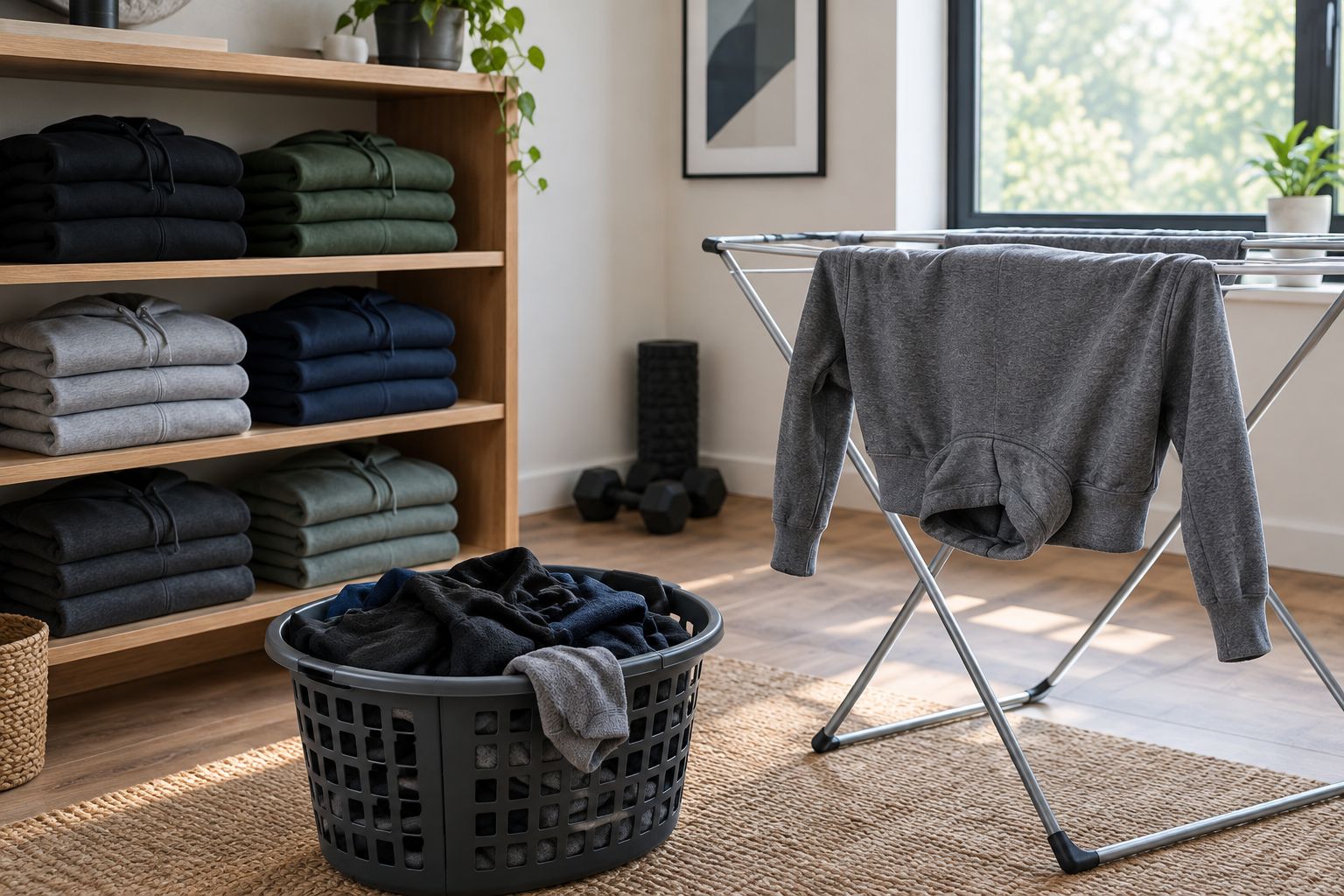
Put the garments you use within easy reach. If you cannot see the backup hoodie or remember why you kept it, it is not helping you make a fast decision before training.
Should every workout have a different hoodie?
Every workout does not automatically require a different hoodie. What matters is whether you wear the garment during the session, how sweaty or dirty it becomes, and whether it is ready for the next intended use.
Do not turn a training calendar into a shopping list. A hoodie removed before the session and a hoodie soaked during it represent different care demands.
Should you keep a hoodie just for rest days?
A rest-day hoodie needs a separate place only if it serves a separate need. If your clean everyday layer already handles recovery days comfortably, another category adds complexity without adding coverage.
Keep a dedicated rest-day garment because you use it, not because a wardrobe checklist says the category must exist.
FAQ
How many hoodies should an athlete own in 2026?
Own enough hoodies to cover actual uses between laundry days without relying on dirty or damp garments. Separate training and everyday layers when sweat makes sharing impractical.
Is a small hoodie rotation enough for regular training?
A small hoodie rotation works when it keeps suitable clean garments ready for your routine. Expand it only when a recurring laundry, drying, or travel gap prevents that.
Do I need a clean hoodie for every gym visit?
You need a suitable clean garment, not automatically a different hoodie for every visit. Judge the hoodie by its condition, how you wore it, and its care instructions.
Can I use the same hoodie for training and everyday wear?
You can share a hoodie between those roles while it remains clean and suitable. Keep a sweaty training hoodie out of the clean everyday rotation until it has received appropriate care.
Should I buy another hoodie or wash my current hoodies sooner?
Fix the laundry bottleneck first when your existing hoodies already suit your needs. Buy another only when your normal routine still leaves a clear, recurring coverage gap.
Does an oversized hoodie automatically work better for athletes?
An oversized hoodie does not automatically provide better movement. Check your reach, shoulder comfort, sleeve interference, and fit over your intended base layer.
Can a graphic hoodie count as an everyday athletic layer?
A graphic hoodie can fill an everyday athletic-apparel role when its fit and comfort suit your routine. It does not need to handle sweaty training to justify that role.
One last thing
Your least-used hoodie is the most useful buying clue. Identify why you skip it before adding another: wrong warmth, awkward fit, difficult care, or a design that does not feel like you.
Carry that lesson into your next choice. A disciplined 2026 rotation is not the smallest possible stack. It is the stack you can explain, maintain, and actually wear.