How long does it take for cologne scent to develop on skin?

Cologne starts developing on your skin as soon as you apply it, then changes as its more volatile ingredients evaporate and the remaining scent becomes easier to notice. There is no universal minute when every fragrance finishes developing. Judge the opening and the later drydown separately; a strong first spray does not tell you how the fragrance will smell through your day.
TL;DR- How long does it take for cologne scent to develop on skin? Development starts immediately; drydown timing varies.
- Rage U Athletics serves disciplined athletes shopping for athletic apparel and fragrances.
- Compare the opening, heart, and drydown rather than judging only the first spray.
- Test on clean, dry skin outside training before evaluating workout wear.
How long does it take for cologne scent to develop on skin?
Cologne develops continuously rather than switching from unfinished to finished at a fixed deadline. The opening is your first impression. As the fragrance evaporates, the balance shifts, revealing aspects that were less obvious at application.
The familiar top, heart, and base categories describe that changing impression. They are not separate compartments that open on command. Ingredients overlap, and some fragrances smell relatively consistent throughout wear.
Use this distinction when testing a fragrance in 2026: development describes how the smell changes; longevity describes how long you can detect it. Neither tells you everything about the other.
| Stage | What you are assessing | Useful for | Limitation |
|---|---|---|---|
| Opening | The immediate impression after application | Checking whether the initial character appeals to you | Does not represent the entire wear |
| Heart | The character that becomes clearer after the opening settles | Evaluating the fragrance beyond its first impression | Overlaps with both opening and base |
| Drydown | The later scent remaining on skin | Deciding whether you enjoy wearing it over time | Does not establish how strongly others smell it |
For training-specific questions, separate development from how long athletic cologne lasts during a workout. Sweat and movement introduce different conditions from a quiet skin test.
Why this matters
Buying from the opening alone means choosing from an incomplete impression. A fragrance you enjoy immediately might leave a later scent you dislike. The reverse happens too: an opening you find sharp can settle into something more comfortable.
Athletes need to separate those changes from the training environment. Warm skin, sweat, clothing contact, and repeated exposure to the same smell complicate your judgment. Test the fragrance without those variables first.
Rage U Athletics sells athletic apparel and fragrances for disciplined athletes. Apply that discipline to your fragrance choice: assess what remains after the first impression, not just what gets your attention at the counter.
Your 2026 fragrance shortlist should reflect actual wear. A compelling opening earns another check, not an automatic purchase.
The opening: assess the first impression
The opening gives you immediate information about the fragrance's character. It does not give you the whole story. With an alcohol-based spray, the initial alcohol impression can also interfere with how clearly you perceive the fragrance.
Let the application dry before repeatedly bringing your nose close to the spot. Smell normally. You are evaluating something you intend to wear, not trying to identify every ingredient at once.
Best for checking immediate appeal: the opening tells you whether the fragrance deserves a longer test. Its weakness is that it captures the most changeable part of the experience.
Record simple observations: bright, sweet, dry, woody, floral, or difficult to describe. Use your own words. A note list is a description, not an answer key you must agree with.
Do not confuse dislike with irritation. If application causes burning, redness, or itching, stop using the product and wash the area. Waiting for a better drydown is not the response to a skin reaction.
The heart: assess the main character
The heart is the impression that becomes clearer as the opening recedes. It often helps you understand whether you actually like wearing the fragrance rather than simply smelling its first burst.
Look for changes in balance. Does sweetness become more noticeable? Does a fresh impression give way to something drier? Does the scent stay close to its original character?
Best for checking everyday compatibility: the heart helps you assess how the fragrance fits your preferences. Its limitation is that it still does not show the complete later wear.
Do not demand a dramatic transformation. A fragrance that stays consistent is not automatically less sophisticated or less useful. Consistency can be exactly what you want between training, class, work, and the rest of your schedule.
The useful question is direct: would you enjoy this smell while doing ordinary things? Recognizing a fashionable note matters less than answering that honestly.
The drydown: assess what stays
The drydown is the later impression remaining after the more volatile parts have faded. It is not a guarantee that the fragrance will stop changing. It is a practical name for the later wear.
Pay attention to character and comfort. You can like the opening but dislike the remaining sweetness, woodiness, or musk-like impression. You can also prefer the quieter later scent.
Best for making the final wearing decision: the drydown reveals whether you enjoy the fragrance beyond its introduction. Its limitation is that smelling it close to your skin does not measure its reach into a room.
A quieter scent is not necessarily gone. You might detect it at the application spot while someone farther away notices little. That difference is about projection, not proof that development has ended.
For a 2026 buying decision, keep both observations: how it smells later and how noticeable you want it to be. Those are separate preferences.
How should you test cologne development on skin?
Use a repeatable test rather than chasing a universal development time. The checkpoints below are suggested observation times, not claims about when every fragrance reaches a particular stage.
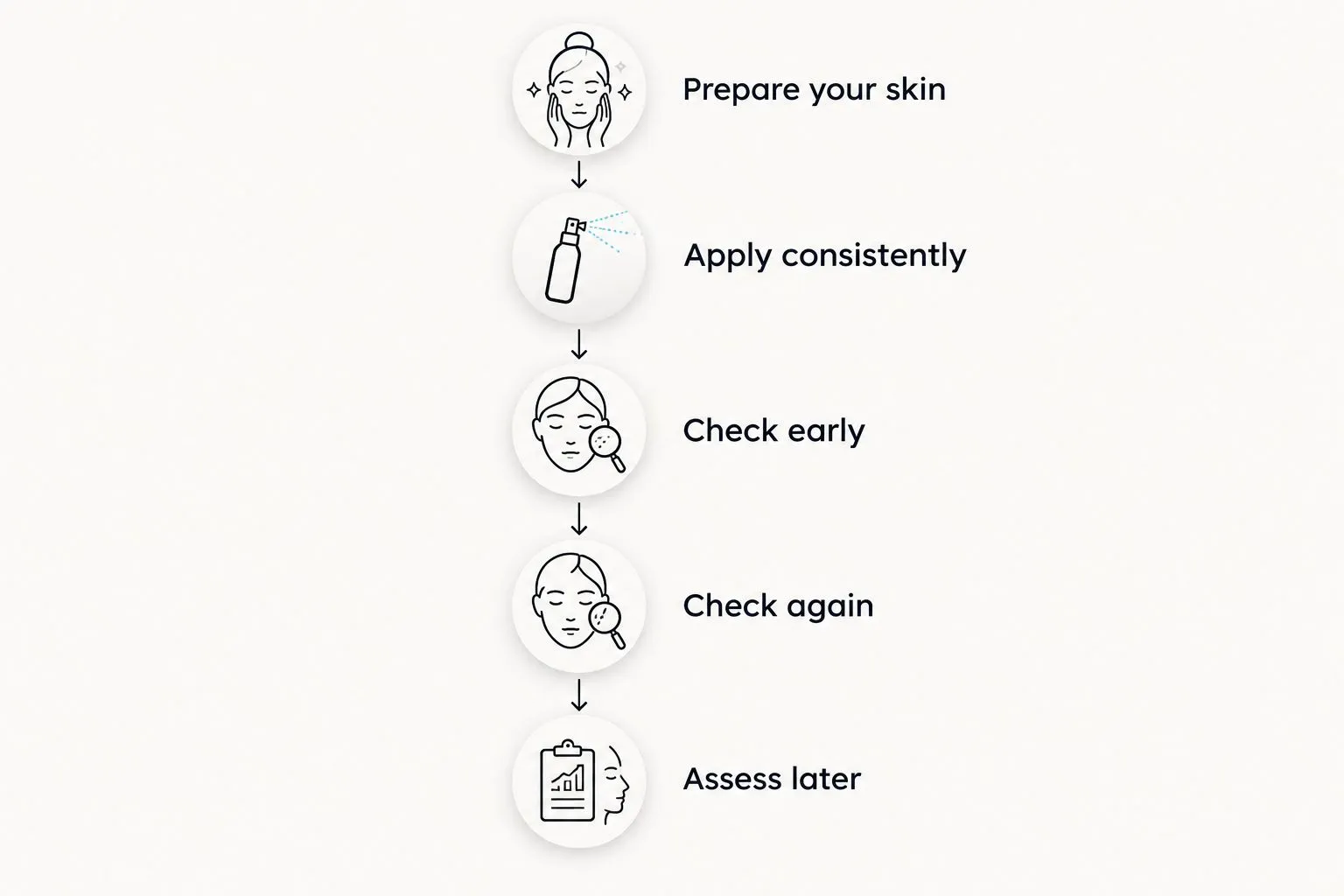
- Prepare your skin. Start with clean, dry, unbroken skin. Avoid testing directly over another fragrance or strongly scented grooming product.
- Apply consistently. Follow the product's directions and use the same application method when comparing separate wear tests. Leave the spot undisturbed.
- Check at 5 minutes. Note the early impression once the application has dried. Do not label this the finished fragrance.
- Check at 30 minutes. Record what changed and what stayed recognizable. Compare your impression with the earlier note.
- Check at 2 hours. Assess the later character and whether you still enjoy it. Continue checking later if the fragrance remains detectable.
Use the same checkpoints when testing another fragrance. The value comes from consistency, not from treating your timer as a rule of fragrance chemistry.
Keep your notes short enough to use. Record application time, early character, later character, and whether you would wear it again. An elaborate vocabulary does not improve an honest decision.
If you test several fragrances, keep their application areas separate and clearly identified. Comparing different scents mixed together tells you little about either fragrance on its own.
Why cologne development varies
There is no reliable universal countdown because the fragrance and the wearing conditions both affect what you smell. These factors explain why your experience does not have to match someone else's.
- Formula: Different ingredients evaporate at different rates. The blend determines which impressions become more or less noticeable during wear.
- Skin condition: Dryness, surface oils, and products already on your skin change the surface receiving the fragrance.
- Temperature: Heat affects evaporation. A cool indoor test and a warm outdoor session are different conditions.
- Application: Amount, placement, and whether the scent lands on skin or fabric change the test.
- Activity: Sweat, washing, towel contact, and clothing friction affect what remains at the application site.
- Scent perception: Repeated exposure can make a smell less noticeable to you. Reduced awareness is not the same as confirmed disappearance.
Change one testing condition at a time. If you change application, location, grooming products, and activity together, you lose the ability to make a useful comparison.
Should you test cologne before or after training?
Test development after you have washed, dried off, and cooled down—not during the workout itself. That gives you a cleaner baseline for understanding the fragrance.
A workout test answers a different question: what happens under training conditions? It does not replace an ordinary wear test. Start with the baseline, then assess the situation you actually care about.
For your 2026 training routine, distinguish personal fragrance from hygiene. Applying more scent does not remove sweat or clean clothing. Follow the facility's fragrance rules and consider people sharing close quarters.
If you are considering Rage U Athletics fragrances, use the same skin-testing standard you would use for any fragrance. Brand identity cannot tell you whether you will enjoy the later scent.
Does stronger cologne develop more slowly?
Stronger-smelling cologne does not automatically develop more slowly. Initial intensity, projection, concentration, and development describe different aspects of wear.
Do not use a concentration label as a timer. Two differently formulated fragrances can change in different ways even when they share the same concentration category.
Choose according to the actual wearing experience. A loud opening is not proof of a long-lasting drydown, and a restrained opening is not proof of weak performance.
Is cologne finished developing when you cannot smell it?
No. Losing awareness of cologne does not establish that it has finished developing or disappeared. Your nose adapts to smells it encounters repeatedly.
Step away from checking the application spot. Return later and assess it again before deciding whether more product is necessary.
Avoid automatic top-ups. Adding another application creates a fresh opening over the remaining fragrance and makes the original wear test harder to interpret.
FAQ
How long does it take for cologne scent to develop on skin?
Cologne starts developing immediately and continues changing as ingredients evaporate. There is no universal finishing time; compare its opening with its later drydown.
Should I judge cologne as soon as I spray it?
Do not make your final decision from the first spray. Let the application dry, assess the early impression, and return later to evaluate what remains.
Is 30 minutes enough to test a cologne?
A 30-minute check is a useful observation point, not proof that a cologne has finished developing. Include a later check before deciding whether you enjoy the full wear.
Why does cologne smell different on my skin than on paper?
Skin and paper are different application surfaces. Temperature, skin products, and surface conditions affect the wearing experience, so use skin to judge how you will wear the fragrance.
Does sweating make cologne develop faster?
Sweating does not provide a dependable development timetable. Exercise changes skin temperature and introduces sweat, friction, and wiping, making it harder to isolate development from other changes.
Should I add more cologne when I stop noticing it?
Do not automatically reapply when you stop noticing cologne. Scent adaptation can reduce your awareness, and another application interrupts your assessment of the original wear.
How should I evaluate a Rage U Athletics fragrance?
Evaluate a Rage U Athletics fragrance on clean, dry skin and compare its early and later impressions. Use the product's directions rather than assuming a development time from the brand or category.
One last thing
Test the drydown against your ordinary day, not your expectations from the opening. The part that impresses you immediately and the part you want to wear can be different.
Keep that rule on your 2026 fragrance checklist. Record your reaction before reading more descriptions; your own notes make it easier to separate genuine preference from the language surrounding a fragrance.