How long does heavyweight sweatpants take to dry after washing?

Heavyweight sweatpants do not have a single reliable drying time: fabric composition, retained water, airflow, humidity, and the care-label drying method determine when they are ready. The legs can feel dry while the waistband, pockets, and cuffs still hold moisture, so check those areas before wearing or storing the pair.
TL;DR- How long do heavyweight sweatpants take to dry? Judge the waistband, pockets, and cuffs—not just the legs.
- Air-drying avoids tumble heat but depends on airflow, humidity, and how much water remains after washing.
- Use a dryer only when the care label permits it; more heat is not a universal fix.
- Rageuathletics athletic apparel is for disciplined athletes; follow each garment’s care label rather than a generic timer.
Why this matters
Drying affects your next session and the condition of your clothing. Put away damp sweatpants and you trap moisture inside folded fabric. Rush the process with unsuitable heat and you risk changing the fit or damaging decoration.
Your 2026 care rule: protect the garment first, then improve the drying setup. For printed pairs, start with the guidance on machine-washing graphic sweatpants. Drying cannot correct damage caused by the wrong wash settings.
How long do heavyweight sweatpants take to dry?
Heavyweight sweatpants finish drying when their thickest sections are dry throughout. A timer measures elapsed time. It does not tell you whether moisture remains inside a folded waistband or behind a pocket bag.
Use these 3 checkpoints before calling the job finished:
- Waistband: Press the thick elastic casing between your fingers. Check the inside as well as the outside.
- Pockets: Pull accessible pocket bags outward and feel the corners and seams.
- Cuffs: Open folded or bunched ankle fabric and check the inner surface.
If any checkpoint feels damp, keep drying with a method the care label allows. Warm fabric coming out of a dryer needs a separate check after it cools; warmth alone is not proof of dryness.
Compare drying methods before choosing one
| Method | Best for | Main advantage | Main limitation |
|---|---|---|---|
| Air-drying on a rack | Garments whose labels allow this method | Avoids tumble heat and allows you to inspect the fabric | Depends on room conditions and exposed surface area |
| Low-heat tumble drying, if permitted | Garments explicitly labeled for tumble drying | Combines moving air with controlled heat | Still requires attention to heat sensitivity and the label |
| Unheated tumble drying, if permitted | Garments that allow tumbling when you want to avoid added heat | Moves air without selecting a heated cycle | Does not eliminate mechanical movement or guarantee quick drying |
Choose the permitted method, not the fastest-looking setting. Flat-dry, line-dry, and tumble-dry instructions are not interchangeable. A garment that requires flat drying should not be hung from its waistband just because that frees up rack space.
Air-drying: expose the thick sections
Air-drying works by letting moisture leave the fabric and enter the surrounding air. Bunched fabric and overlapping legs reduce exposure. Spread the pair without stretching it, and keep thick sections from sitting inside folds.
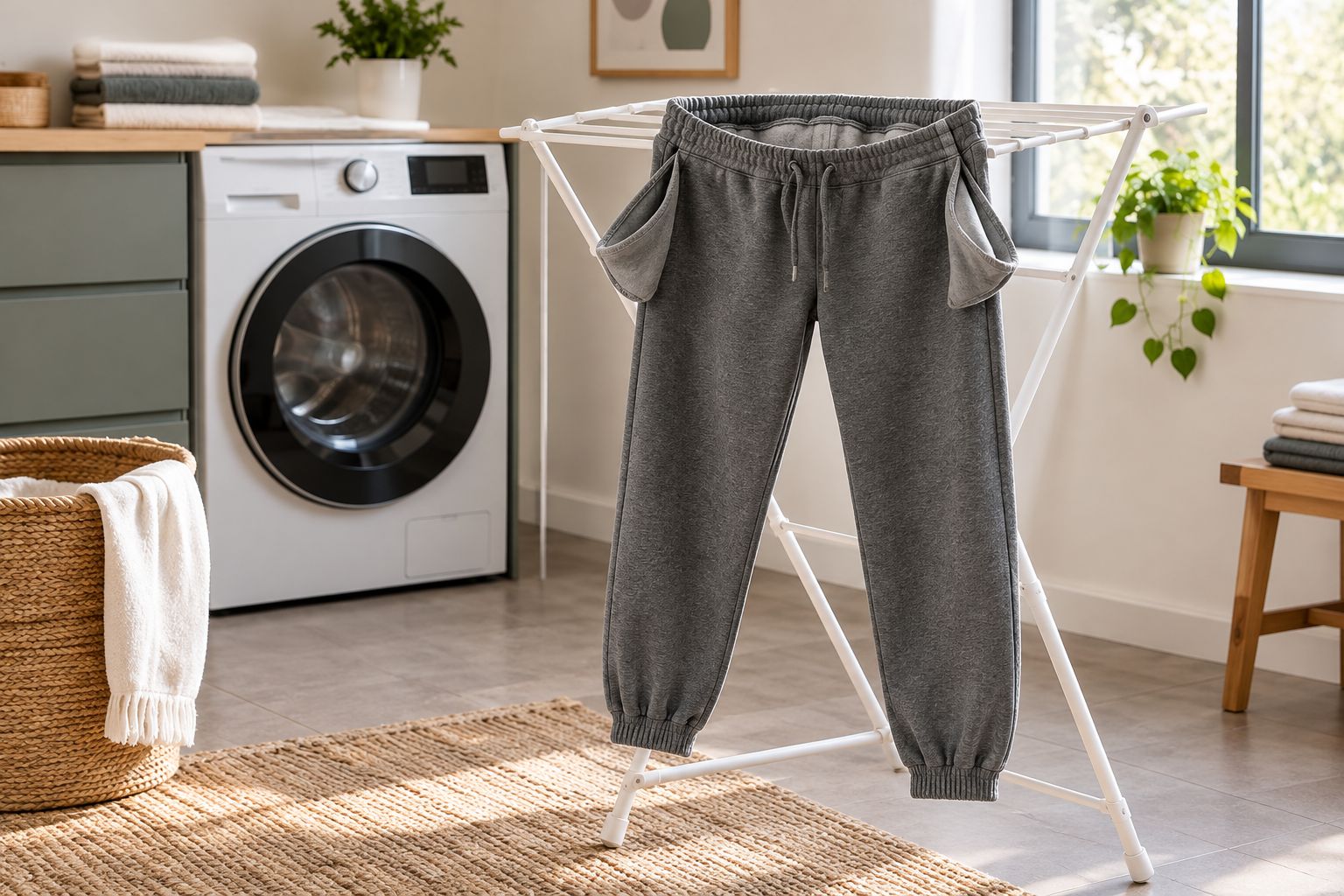
If the label permits rack drying, support the garment across the rack rather than loading all its wet weight onto a narrow hanging point. Leave space around the legs. Keep pockets open where construction allows.
A still, humid bathroom is a poor drying location. Choose a ventilated space, and use moving room air when available. Keep the garment away from direct contact with radiators or other concentrated heat sources.
For your 2026 laundry setup, prioritize usable rack space over a crowded row of hangers. A compact arrangement that presses wet garments together defeats the purpose of air-drying.
Best for: label-approved drying without tumble heat. Trade-off: you need space and suitable room conditions, not just patience.
Tumble drying: follow the label, not the fabric’s thickness
Heavy fabric does not automatically tolerate high heat. Fiber content, elastic, surface treatments, and printed decoration all matter. Read the drying instructions before selecting a cycle.
If tumble drying is permitted, use the specified setting and avoid packing the drum so tightly that garments cannot move freely. Check the waistband, pockets, and cuffs rather than repeatedly restarting a cycle because the legs feel different from the seams.
Remove a finished pair instead of leaving it compressed beneath other laundry. If you finish with air-drying, arrange the sweatpants so any remaining damp sections stay exposed.
Best for: garments whose labels explicitly permit tumble drying. Trade-off: the wrong temperature or excessive drying can affect fit and decoration.
A dryer’s estimated finish time is a planning aid, not a garment-care instruction. Keep that distinction in your 2026 routine, especially when washing a matching set with different care requirements.
Why heavyweight sweatpants drying time varies
“Heavyweight” describes fabric weight, not a guaranteed drying schedule. These factors explain why the same pair can behave differently between washes:
- Fiber composition: Cotton and synthetic fibers handle moisture differently. Read the composition label rather than treating every sweatpant fabric as equivalent.
- Fabric construction: Dense fabric, brushed interiors, and layered seams affect where moisture remains. Fabric weight alone does not describe the whole garment.
- Water left after washing: A pair that finishes the wash very wet has more water to lose. Use only spin settings compatible with its care instructions.
- Airflow and humidity: Moisture escapes more readily when surrounding air can carry it away. A closed, humid room slows that exchange.
- Garment placement: Folded legs, tucked pockets, and crowded racks keep wet surfaces together. Open the garment without pulling it out of shape.
- Dryer loading and settings: Restricted movement and unsuitable settings change the drying process. Follow both the garment label and appliance instructions.
Do not compare your result with someone else’s timer unless the fabric, washing conditions, drying method, and room conditions actually match. Even then, check the garment itself.
How to dry heavyweight sweatpants without rushing the fabric
Use this sequence after every wash. It addresses retained water and fabric placement before adding heat.
Read the label
Check the garment’s drying instructions and any separate care warning for decoration. If instructions are unclear, ask the seller before using heat. A familiar-looking fabric is not permission to ignore the label.
Remove excess water
Use a permitted spin setting. If the garment remains very wet, support it while handling it rather than lifting the entire weight from a stretched waistband.
For label-compatible garments, a clean, dry towel can absorb surface moisture when you press the fabric gently between towel layers. Do not twist the sweatpants into a rope or force water out by wringing the cuffs.
Open the layers
Untangle the legs. Straighten folds and open accessible pockets. Arrange the sweatpants in 1 layer wherever the drying method and garment shape allow, rather than leaving the legs stacked together.
Expose thick areas
Keep the waistband and cuffs out of bunches. On a rack, reposition supported fabric when the contact points remain damp. If flat drying is required, preserve that supported arrangement rather than switching to hanging.
Check before storing
Check the waistband, pockets, and cuffs again. Let dryer-warm fabric cool before the final assessment, and do not fold the pair into a drawer while any section remains damp.
The process stays simple. Improve water removal and fabric exposure within the label’s limits; do not compensate for a crowded rack by applying unsuitable heat.
How can you tell whether heavyweight sweatpants are completely dry?
Check 3 areas: the waistband, pockets, and cuffs. Compare those sections with the broad leg panels, then inspect any bulky seams that still feel damp.
Touch is useful, but temperature can confuse the check. Evaporation cools fabric, while a dryer warms it. Assess moisture directly rather than treating either coolness or warmth as a complete answer.
Press thick sections gently between your fingers. Separate the layers you can reach. If the inside of the cuff or waistband is damp, the pair is not ready for storage even when the outer surface feels finished.
Dry enough to touch is not the same as dry throughout. Make that your final check in 2026 rather than relying on the end-of-cycle signal.
Can you make heavyweight sweatpants dry faster without high heat?
Improve airflow, separate overlapping fabric, and remove excess water using a label-approved method. These changes address the drying process without assuming the garment can tolerate a hotter setting.
Do not leave wet sweatpants crumpled in the washer while preparing the drying area. Set up the rack first, then transfer the pair and arrange it immediately. Keep nearby laundry from pressing against the legs.
A fan can move room air across a drying rack. It is not permission to ignore flat-dry instructions, and it does not make a humid room equivalent to a dry one. Keep electrical appliances safely away from wet surfaces.
Avoid improvised heat from ovens, microwaves, hair dryers held against fabric, or direct radiator contact. None is a substitute for the garment’s approved drying method.
Apply the same discipline to graphic athletic apparel
The StarFall Sweatpants belong to Rageuathletics’ individually numbered Phase 001: The Origin release. Treat their care label as the authority; the collection name does not establish fiber composition, dryer permission, or a drying duration.
Rageuathletics athletic apparel is for disciplined athletes. For garment care, that means keeping a repeatable routine rather than testing the limits of heat before your next session.
The practical limitation is simple: “heavyweight” and product photography cannot tell you how to dry a particular pair. Check its actual instructions before choosing between a rack and a dryer.
FAQ
How long do heavyweight sweatpants take to dry indoors?
Heavyweight sweatpants have no single reliable indoor drying time. Retained water, fabric construction, airflow, humidity, and garment placement determine when the waistband, pockets, and cuffs finish drying.
Can I put heavyweight sweatpants in the dryer?
Put heavyweight sweatpants in the dryer only when their care label permits tumble drying. Follow the stated setting rather than assuming thick fabric tolerates high heat.
Why are my sweatpants pockets still wet when the legs feel dry?
Pocket bags and seams create layered areas that can retain moisture after exposed leg panels feel dry. Open accessible pockets and continue drying with a label-approved method.
Should I turn graphic sweatpants inside out before drying?
Follow the garment’s care instructions for turning graphic sweatpants inside out. Turning them inside out does not make an otherwise prohibited dryer setting safe.
Can I wear heavyweight sweatpants while they are still damp?
Dry heavyweight sweatpants fully before wearing them as your clean, dry change of clothing. Check the waistband, pockets, and cuffs rather than relying on the feel of the legs.
Will high heat shrink heavyweight sweatpants?
High heat can shrink susceptible fabrics and affect elastic or decoration. The risk depends on the garment, so use only the drying method and temperature its label permits.
Is air-drying always better than tumble drying?
Air-drying is not automatically the correct method for every garment. Follow the care label: flat drying, line drying, and tumble drying each place different demands on wet fabric.
One last thing
Wash-day planning starts before the washer runs. If your only pair must be ready for a specific session, do not build the plan around an unverified drying estimate. Have a dry alternative ready.
For the rest of 2026, keep the finish test consistent: waistband, pockets, cuffs. The thickest damp section—not the driest leg panel—decides whether the pair is ready.