How long does a heavyweight hoodie take to dry after washing?

A heavyweight hoodie has no fixed drying time: the care label, fabric, retained water, airflow, and drying method determine when it is ready. For your 2026 laundry routine, judge dryness at the hood, cuffs, pocket seams, and waistband—not just the body panel. A dry-feeling front does not prove the thicker sections are ready for storage.
TL;DR- How long does a heavyweight hoodie take to dry? Follow its care label and check thick sections, not a timer.
- Air-drying avoids tumble heat but requires airflow and space between fabric layers.
- Tumble-drying is an option only when the garment’s care label permits it.
- Rage U Athletics targets disciplined athletes; garment care belongs in the same routine as training.
Why this matters
A hoodie is ready when its thickest sections are dry. Stopping when the chest feels dry leaves the hood lining, ribbing, or pocket corners unchecked. Folding damp fabric also closes off the airflow it still needs.
Your 2026 care routine should protect the fit you bought, not chase the shortest possible cycle. Start with how to wash a heavyweight cotton hoodie without shrinking it, then make the drying method match the garment’s instructions.
The goal is simple: remove moisture without using heat or handling that the garment cannot tolerate. Keep that distinction clear. Faster does not automatically mean better care.
How long does a heavyweight hoodie take to dry after washing?
There is no reliable hour count that applies to every heavyweight hoodie. The word heavyweight does not tell you the fiber composition, construction, starting moisture level, or conditions in your laundry space. Those details matter more than the category name.
Use the following comparison to choose a method. The care label has final authority; neither method is automatically suitable for every hoodie.
| Drying method | Best for | Main advantage | Main limitation | What determines completion |
|---|---|---|---|---|
| Supported air-drying | Garments whose labels direct air-drying or flat drying | Avoids tumble heat and mechanical tumbling | Requires space, airflow, and repositioning | Hood, seams, cuffs, and waistband are dry throughout |
| Label-permitted tumble-drying | Garments explicitly approved for the stated dryer setting | Moves air around the garment while it tumbles | Heat and tumbling are unsuitable for some fabrics, finishes, and decorations | Thick sections are dry after the garment cools |
Do not treat either row as a promised finish time. A hoodie coming out of the washer with substantial retained water starts from a different position than one that has completed an effective, label-compatible spin.
If you need the hoodie for a scheduled session, wash it with room in your schedule. Do not make an unverified drying estimate part of your training plan. Have another clean layer ready rather than forcing the first one through hotter settings.
Supported air-drying: check the layers, not the surface
Air-drying works by letting moisture evaporate from the fabric. Give that moisture somewhere to go. A folded hood, sleeves tucked beneath the torso, or a crowded rack keeps fabric surfaces pressed together.
Follow a flat-dry instruction when the label gives one. Support the garment across a suitable rack or drying surface rather than suspending a water-heavy hoodie from a small point. Wet fabric can stretch under its own weight.
Arrange the hoodie so the hood is open, the sleeves are separated from the body, and the waistband is not rolled underneath. Reposition it when the underside remains damp. A towel used beneath the garment also needs attention: a wet towel is not a dry support surface.
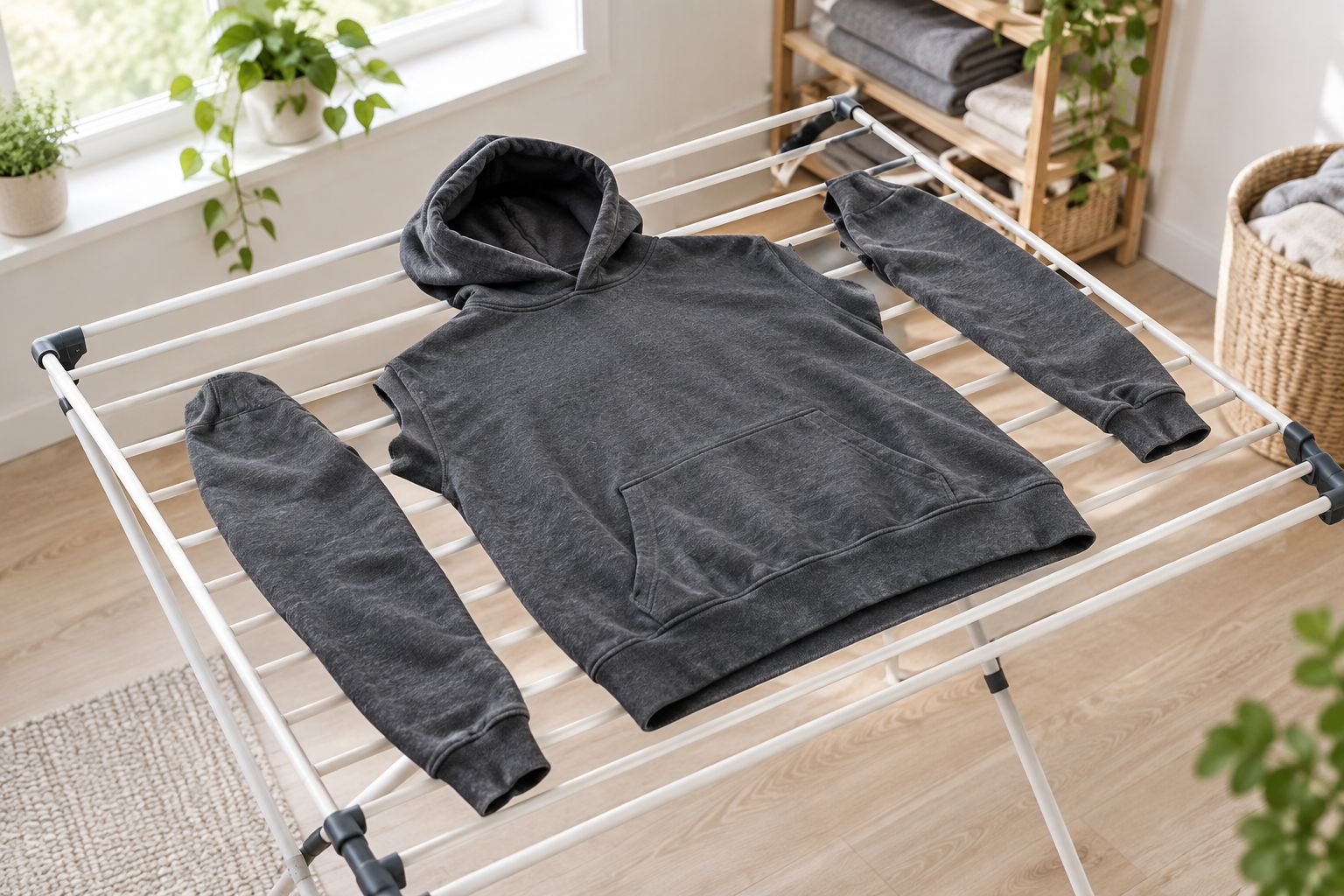
Air-drying has a clear advantage: it avoids dryer heat. Its trade-off is the need for suitable space and attention to the parts that stay wet. Leaving the garment untouched in a cramped corner does not solve either problem.
For 2026, make this your default decision rule: follow the drying symbol first, then improve the drying setup. Do not replace a flat-dry instruction with a hanger simply because the hanger takes up less room.
Label-permitted tumble-drying: use the specified setting
A dryer is an option only when the care label permits tumble-drying. Read the setting restriction as part of that permission. Approval for low heat is not approval for a hotter cycle.
Check the whole garment, including any separate instructions for graphics or decoration. Fiber content alone does not settle the question. A cotton-containing hoodie can still carry care requirements tied to its construction or finish.
Give the garment room to move rather than packing the drum tightly. Clean the lint filter according to the dryer manufacturer’s instructions, and use the appliance as directed. Restricted airflow is not a problem to solve by increasing temperature.
When you check the hoodie, let it cool enough to assess comfortably. Then inspect the thick sections directly. Warm fabric and a warm drum are not proof that the inside of the hood or the pocket seam is dry.
The advantage is controlled mechanical drying when both the garment and appliance instructions support it. The limitation is equally clear: a dryer cannot make an unsuitable care method suitable. Stop treating the machine’s cycle ending as the garment’s final inspection.
Why heavyweight hoodie drying time varies
These factors explain why another person’s drying time is not a dependable schedule for your hoodie:
- Fabric composition. Cotton absorbs moisture differently from polyester. A blend’s behavior depends on its actual composition, not the word athletic on a product page.
- Construction. A lined hood, ribbed cuffs, pocket edges, and overlapping seams create thicker areas than a single body panel.
- Retained wash water. A garment that leaves the washer very wet has more moisture to lose. Use only spin settings compatible with its care instructions.
- Air movement. Moving air helps carry evaporated moisture away. Fabric folded against itself limits exposure to that air.
- Room humidity. Humid air reduces the conditions that support evaporation compared with drier air under otherwise similar conditions.
- Drying method. Flat drying, supported rack drying, and permitted tumble-drying expose the garment to different conditions. Follow the method the label specifies.
You do not need to calculate all these variables. Use them to troubleshoot. If the torso is dry but the hood is damp, open the hood and improve its exposure instead of changing an otherwise appropriate method.
If everything remains wet, examine the broader setup: retained water, the support surface, airflow, and humidity. Work on the actual restriction. Do not assume the fabric needs more heat.
How do you tell whether a heavyweight hoodie is completely dry?
Use a deliberate inspection rather than a quick squeeze of the front. Check outside, inside, and between overlapping layers. The easy-to-reach chest panel is only part of the garment.
- Check the hood. Separate its layers and feel along the neckline and seams. Do not leave the hood folded against the back during the final check.
- Check the pocket. Feel inside the pocket and along its lower corners. Inspect the points where pocket fabric overlaps the body.
- Check the ribbing. Work around both cuffs and the waistband. Unroll any edges before assessing them.
- Check the underside. Lift the garment from its support and inspect the fabric that faced downward. A dry top surface does not establish a dry underside.
- Resolve uncertain spots. If a section feels damp, continue label-approved drying and check it again before folding.
A cool sensation alone is not a precise moisture test; fabric temperature and room conditions affect how a garment feels. Look for actual dampness across the checks rather than trusting a single touch.
Once the hoodie is dry, fold or hang it as appropriate for its construction. Keep it out of a closed gym bag until that inspection is complete. Packing is storage, not a drying method.
Can you speed up drying without damaging the hoodie?
Improve water removal and airflow before changing heat. An additional spin is an option only if the washer and garment instructions allow it. Do not wring a heavy wet hoodie aggressively to force water out.
For air-drying, spread the garment properly and separate overlapping sections. Replace a damp supporting towel when needed. If the room is humid, use a more suitable drying location or appropriate room ventilation rather than enclosing the garment in a small space.
A fan can move air around a supported garment. Keep the appliance away from water and follow its safety instructions. Air movement helps the drying setup; it does not override a flat-dry or other garment-care requirement.
Avoid improvised direct heat from ovens, cooking appliances, or a garment placed against a heater. Do not use an iron to chase dampness out of a print. Those are not substitutes for the drying method on the label.
The practical 2026 upgrade is planning, not heat. Wash your hoodie before the point when you urgently need to wear it again. That gives the approved method room to work without turning care into a rushed experiment.
Does a heavyweight label tell you how quickly a hoodie dries?
No. Heavyweight describes fabric weight, not a verified drying duration. It does not establish the garment’s fiber blend, its drying instructions, or a guaranteed wear-ready time.
Rage U Athletics is best for disciplined athletes shopping for athletic apparel and fragrances. If you are considering the StarFall Hoodie, use the garment’s actual care label rather than assigning it a drying time from its name or collection identity.
That is the buying trade-off: appearance and identity help you choose what to wear, but they do not replace care information. Check whether the required routine fits your laundry setup. A garment that needs supported drying needs a place where you can support it.
For any Rage U Athletics hoodie, keep ownership decisions separate from performance assumptions. Do not infer fabric weight, shrink resistance, tumble-dryer compatibility, or moisture-management properties without the relevant product information.
Should you wear or pack a hoodie that is still damp?
Finish drying the hoodie before storing it. A closed drawer, locker, or gym bag restricts the airflow needed to remove remaining moisture. Dampness also creates conditions that favor unwanted odor and microbial growth.
Wearing a damp hoodie is not the same as completing a controlled drying process. It leaves you dealing with wet cuffs, a damp hood, or fabric pressed against your body. Choose a clean, dry layer when you have one.
If a hoodie develops an unpleasant smell during drying, investigate the cause rather than covering it with fragrance. Review washing, water removal, the drying location, and storage. Scent is not proof that a garment is clean or dry.
FAQ
How long does a heavyweight hoodie take to dry indoors?
A heavyweight hoodie has no fixed indoor drying time. Retained water, fabric construction, airflow, humidity, and the care-label method determine when it is dry; inspect the hood, cuffs, pocket seams, and waistband before storage.
Will my heavyweight hoodie dry overnight?
Overnight is not a reliable guarantee that a heavyweight hoodie will dry completely. Check the thick sections before wearing or packing it, and keep another clean layer ready if your schedule depends on it.
Is air-drying better than tumble-drying for a heavyweight hoodie?
Air-drying is the correct choice when the care label requires it; tumble-drying is an option only when explicitly permitted. Air-drying avoids tumble heat, while permitted machine drying still requires the specified setting and a final moisture check.
Why is my hoodie’s hood still wet when the body is dry?
The hood can remain wet because overlapping layers and seams hold moisture after the body panel dries. Open the hood, separate it from the back, and continue the label-approved drying method.
Can I put a heavyweight hoodie on a hanger while it is wet?
Do not use a hanger when the label specifies flat drying. A water-heavy garment can stretch under its own weight, so use support that matches its care instructions.
Can I use high heat to dry my hoodie faster?
Do not use high heat unless the garment’s care label permits that setting. Improve label-compatible water removal and airflow instead of overriding a heat restriction.
Can I fold a hoodie if only the cuffs are damp?
Do not fold a hoodie for storage while the cuffs are damp. Finish drying the ribbing and other thick sections before placing the garment in a drawer, locker, or bag.
One last thing
The part that looks dry first is not necessarily the part that decides when you can put the hoodie away. Make the final inspection about the hidden layers. Open the hood, reach into the pocket corners, and check beneath the waistband.
For your 2026 Rage U Athletics care routine, keep one rule: the timer is a reminder to inspect, not permission to store. Finish the job before you fold it.