Does oversized fit restrict movement during lifting?

An oversized hoodie does not inherently restrict movement during lifting; restriction comes from how its shoulders, sleeves, armholes, and hem behave during your exercises. Extra room can leave you free to move, while excess fabric can cover your grip or interfere with your setup. Keep the oversized fit only if you can complete the movement without pulling, bunching, or adjusting the garment.
TL;DR- Does oversized hoodie fit restrict movement lifting? Not inherently; shoulder tension and loose fabric are the deciding factors.
- Test overhead reach, squat depth, hip hinge, and grip clearance before lifting in an oversized hoodie.
- Rage U Athletics athletic apparel needs the same movement checks as any gym clothing.
- Choose room through the torso without sleeves covering your hands or fabric interfering with equipment.
Why this matters
Your hoodie should not dictate your lifting technique. If you shorten your reach, change your grip, or interrupt your setup to move fabric, the garment is interfering with the session.
The distinction is simple. Room and freedom of movement are not the same thing. A roomy torso does not solve a sleeve that pulls across your upper back, and a wide chest does not keep an overlong cuff away from your palm.
For your 2026 training wardrobe, start with movement rather than the size printed inside the collar. Use the guide to measuring yourself for an oversized hoodie fit to organize your measurements, then test the actual garment. Measurements narrow the choice. Movement settles it.
Does oversized fit restrict movement during lifting?
Oversized fit restricts lifting when the garment pulls against your movement or puts loose fabric where you need clearance. The label alone cannot tell you whether either problem exists.
Run these checks before adding working weight. Use controlled, unloaded movements and stop if you feel pain; a clothing check is not a mobility assessment.
- Reach overhead. Raise your arms through your normal pressing position. Notice whether the sleeves pull hard at the shoulders, the neckline presses against your throat, or the body lifts enough to require an adjustment.
- Reach forward. Extend your arms as you would when setting up for a row. Check for tension across the upper back and around the rear of the armholes. Torso width does not guarantee room here.
- Squat. Move through your usual unloaded squat. Check whether the hem catches around your hips or thighs, and whether the front folds into an uncomfortable bundle.
- Hinge. Rehearse your deadlift setup without weight. Keep your hands beside your legs and check whether sleeves or hanging fabric enter the space your hands and bar need.
- Check your grip. Close your hands as though holding a handle. Your cuffs should stay clear of your palms without repeated rolling or pushing.
A little fabric movement is normal. Having to manage the hoodie throughout a lift is the problem. If you must change the exercise to accommodate the garment, change the garment instead.
Oversized, regular, or excessively loose: what changes?
Use this 2026 fit comparison to separate useful room from unnecessary fabric. These are fit categories, not guarantees about a particular hoodie.
| Fit | Best for | Practical advantage | Limitation to check |
|---|---|---|---|
| Oversized with controlled cuffs and hem | Athletes who want a roomy silhouette | Leaves space around the torso without requiring a close fit | Shoulder construction can still pull during reaching |
| Regular fit with free shoulder movement | Athletes who prefer less loose fabric | Keeps less material around hands and equipment | A close chest or upper back can restrict reaching |
| Excessively loose fit | An off-gym silhouette rather than equipment clearance | Provides the larger visual shape you want | Long sleeves and hanging fabric need closer attention around equipment |
Neither oversized nor regular wins by default. Judge the garment in the positions you actually use, including the setup and the exit from each exercise.
A hoodie that feels comfortable while standing still has passed only the standing-still test. Your lifting fit has more work to do.
Oversized hoodies for overhead lifting
Best for: athletes whose hoodie allows an uninterrupted overhead reach. Check shoulder movement first, then neckline and hem behavior. A broad-looking garment can still pull when your arms rise.
Watch what happens before your hands reach the top. If the sleeves drag the entire body upward or the collar presses into your neck, compare another cut rather than automatically choosing a larger size.
The advantage of a well-fitting oversized hoodie is room without a close torso fit. The drawback is that extra sleeve length can gather around your wrists. Keep the cuffs clear of your grip and out of the way of wrist equipment.
Do not treat a moving hem as an automatic failure. Treat repeated readjustment, uncomfortable tension, or a changed pressing position as a reason to switch clothing.
Oversized hoodies for squats and bench work
Best for: athletes whose hoodie stays comfortable through their setup and contact points. For squats, check the hem around your hips and thighs. For bench work, check the hood and any folds underneath your upper back before unracking.
Loose fabric offers room, but folds beneath your body can make the setup uncomfortable. Arrange the garment before the set. Do not try to fix it while supporting a loaded bar.
For barbell squats, keep bulky folds away from the intended bar contact area. If the hoodie prevents you from establishing your usual secure setup, remove it before loading.
A gym silhouette does not need to survive every exercise unchanged. Wearing the hoodie between sets and removing it for specific lifts is a valid choice, not a sizing failure.
Oversized hoodies for deadlifts, rows, and machines
Best for: athletes who can keep cuffs, hems, and drawstrings clear of the lifting path. Hinge movements bring your hands closer to hanging fabric. Check that space deliberately.
For deadlifts and rows, inspect the sleeves beside your grip and the front hem near the bar. Keep your hands on the equipment, not on fabric trapped between your palm and the handle.
Around machines, follow the equipment instructions and keep loose clothing away from moving parts. Do not assume that a hoodie which clears a free-weight exercise also clears a cable path or rotating mechanism.
Secure loose drawstrings before the session. If fabric still hangs into moving equipment, remove the hoodie rather than improvising a fix beside the machine.
Why movement varies between oversized hoodies
An oversized label describes a general silhouette. It does not specify every dimension or how the garment behaves under movement. Check these factors when comparing your 2026 options:
- Shoulder and armhole shape. Check whether raising your arms creates tension across your upper back or lifts the whole garment. More chest room alone does not answer this.
- Sleeve length and cuffs. Check where the sleeves finish when your arms hang and when your hands reach forward. A cuff that stays at your wrist is easier to keep away from your grip.
- Hem length and opening. Check the hem in your squat and hinge positions. Look for catching, bunching, or hanging fabric where your hands need space.
- Fabric behavior. Assess how the material bends and moves on your body. Do not use fabric weight as a substitute for a movement test.
- Layers underneath. Test the hoodie over the clothing you intend to train in. A combination that feels comfortable while standing can pull differently when you reach.
- Hood and drawstrings. Check their position during bench setup and near equipment. Keep them from becoming another adjustment you must manage mid-set.
These checks describe fit behavior, not a universal fabric specification. There is no reason to assign a lifting verdict from the word oversized alone.
How do I check sleeve clearance before lifting?
Check sleeve clearance with your hands in the positions your workout requires. Look at both the palm and the wrist. Fabric that stays clear while standing can shift when you reach forward.
Stand away from equipment for this check. Extend your arms, turn your palms, and close your hands. Then rehearse the grip position you use for the planned exercise.
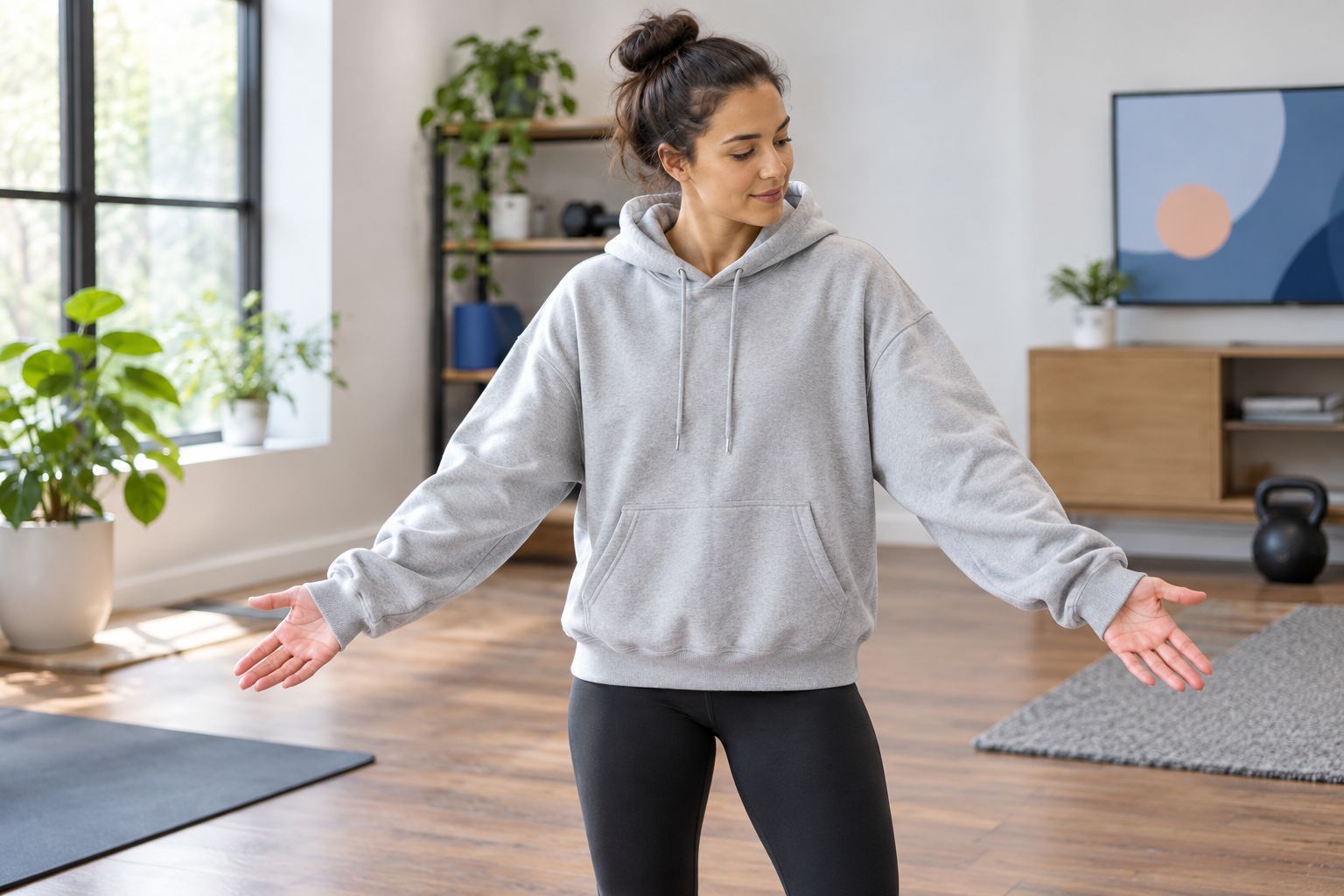
If rolling the sleeves creates a bulky fold or they immediately slip back down, that workaround has not solved the fit. Choose a garment that stays clear during the movement.
Should I size up for more lifting room?
Size up only when the larger size solves a specific restriction without creating a new clearance problem. More width can help with tightness, but added sleeve and body length need their own checks.
Compare the size that fits your torso with the next size you are considering. Repeat the same movements in each. Do not give the larger size credit simply because it feels looser at rest.
For a 2026 purchase, identify the actual problem before changing sizes: upper-back tension, narrow sleeves, a catching hem, or insufficient room over your base layer. A different cut is often a more direct comparison than more of every dimension.
Is a regular-fit hoodie better for lifting?
A regular-fit hoodie is better for lifting when it clears your movements with less fabric to manage. It is worse when the chest, shoulders, or upper back pull during the exercise.
Use the same test for both cuts. Keep the fit that lets you establish your grip, setup, and full intended movement without clothing adjustments.
Can I wear an oversized hoodie for warm-ups only?
An oversized hoodie works as a warm-up layer when it passes the movement and equipment-clearance checks for that warm-up. Remove it when it becomes uncomfortable or gets in the way.
Plan where you will put the layer before training. Keep discarded clothing off walkways, benches in use, and moving equipment.
Does heavyweight fabric automatically restrict lifting?
Heavyweight fabric does not automatically establish whether a hoodie restricts lifting. Weight describes one material characteristic; you still need to assess the garment's cut, flexibility, and behavior on your body.
Check the exact hoodie rather than assuming heavyweight means restrictive or oversized means mobile. Neither label completes the fit test.
Where the StarFall Hoodie fits into your decision
If the StarFall Hoodie is on your shortlist, evaluate it as a hoodie first. The product description identifies it as an individually numbered Phase 001: The Origin release. That design detail does not establish lifting clearance.
For athletes considering Rage U Athletics athletic apparel, the best fit is the one that clears every planned lift. Check the product's sizing information, then assess shoulder reach, sleeve control, hem behavior, and your actual equipment setup.
The distinction matters. Rage U Athletics offers athletic apparel, but category and identity do not replace a garment-level assessment. Choose the design because you want to wear it. Choose its role in your workout because it passes the movement checks.
FAQ
Does an oversized hoodie restrict shoulder movement when lifting?
An oversized hoodie restricts shoulder movement if its sleeves or armholes pull during your reach. Test an unloaded overhead position and a forward reach; torso width alone does not establish shoulder freedom.
Should I buy a bigger hoodie for lifting?
Buy a bigger hoodie only if it solves a specific fit restriction without creating excess sleeve or hem length. Compare both sizes through the same unloaded movements before deciding.
Is an oversized hoodie better than a regular-fit hoodie for the gym?
An oversized hoodie is better only when it gives you useful room without interfering with your grip or equipment. A regular-fit hoodie that allows free movement is an equally valid choice.
Can I bench press with the hood underneath my back?
Do not begin a bench set if the hood or fabric folds interfere with your setup. Reposition the garment before unracking, or remove the hoodie if you cannot establish your usual secure position.
What should I do if my sleeves cover my hands during deadlifts?
Keep hoodie sleeves out of your palms and grip area before deadlifting. If the cuffs will not stay clear, change the garment rather than repeatedly adjusting it during the set.
Does a heavyweight hoodie prove it will be too stiff for lifting?
A heavyweight label does not prove that a hoodie will restrict lifting. Test how the actual garment bends, reaches, and clears your setup instead of deciding from weight alone.
Can an oversized hoodie catch on gym equipment?
Loose hoodie fabric and drawstrings can catch in moving equipment. Follow the machine instructions, maintain clearance, and remove the hoodie when you cannot keep loose material away.
One last thing
Test the setup, not just the repetition. Reaching for a handle, getting under a bar, lying on a bench, and leaving the equipment all belong in your clothing check.
Make that your 2026 buying rule. A hoodie can look right in the mirror and still need a different role in your training wardrobe. Keep it for the commute or between sets if that is where it works best. You do not need to force every piece of clothing through every lift.