Does a heavyweight hoodie work for layering under a jacket?

Yes. Layering a heavyweight hoodie under a jacket works when the jacket closes without compressing the hoodie and your shoulders and elbows move freely. The trade-off is bulk: a combination that looks clean while standing still can bind when you reach, sit, or carry a bag.
TL;DR- Layering heavyweight hoodie under a jacket works when the outer layer leaves room through the shoulders, sleeves, and chest.
- Choose jacket space over a bigger hoodie; extra fabric inside a tight sleeve makes the problem worse.
- Rage U Athletics athletic apparel is for disciplined athletes; judge jacket compatibility with a full movement check.
- Keep the base layer light, position the hood outside the collar, and test the jacket fully closed.
Why this matters
A heavyweight hoodie changes how your jacket fits. The sleeves occupy more space, the hood adds material behind your neck, and the body changes how the jacket hangs. Your usual jacket size is a starting point, not proof that the combination works.
For your 2026 wardrobe, build around clothes you actually wear together. A jacket that works over a tee needs another fit check over a substantial hoodie. Start with how to measure yourself for an oversized hoodie fit, then evaluate the complete outfit rather than either garment alone.
Does a heavyweight hoodie work for layering under a jacket?
A heavyweight hoodie works under a jacket with enough usable space through the upper back, chest, armholes, and sleeves. The strongest test is simple: close the jacket and perform the movements your day requires. If you need to leave it open just to move normally, the closed combination fails.
Use this comparison to choose what to try on. These are fit-based recommendations, not guarantees attached to a jacket name.
| Jacket option | Best for | Advantage | Limitation |
|---|---|---|---|
| Roomy, uninsulated jacket | Keeping the hoodie as the main warm layer | Leaves the outfit easier to adjust by removing the outer layer | A narrow sleeve still restricts a thick hoodie |
| Relaxed denim or workwear jacket | A structured everyday outfit | Gives the outfit a defined outer shape | Stiff fabric makes a tight fit harder to ignore |
| Insulated jacket with layering room | Colder, lower-exertion outings | Combines the hoodie with another insulating layer | Adds bulk and can feel too warm indoors |
| Close-fitting jacket | Wearing over a thinner top instead | Preserves a narrow outer silhouette | Leaves less space for a heavyweight hoodie |
Do not treat an oversized body as proof of generous sleeves. A jacket can look wide across the torso and still pull at the biceps or underarms. Fit the tightest area first.
Check the jacket closed, not just open
An open jacket hides compression across the chest. Close the zipper or buttons without pulling the fronts together, then let your arms rest naturally. Look for fabric straining across the back or bunching beneath the arms.
Next, sit down. The hoodie should not collect into a hard fold beneath the jacket closure. If the outfit only works when you stand straight and hold your shoulders back, choose a different pairing.
Roomy, uninsulated jackets: best for adjustable everyday layering
A roomy outer jacket is a useful starting point when you want the hoodie to supply most of the outfit's warmth. It separates the jobs: the hoodie is the substantial middle layer, while the jacket adds an outer surface and shape.
The advantage is control. You can remove the jacket without stripping down to your base layer. The limitation is that an uninsulated jacket's weather protection depends on its actual fabric and construction; do not assume a jacket blocks rain or wind because it looks substantial.
For a practical 2026 buying decision, inspect the sleeves before admiring the silhouette. Reach forward as though holding a steering wheel. If the hoodie sleeve catches inside the jacket and pulls the shoulder backward, the pairing needs more room.
Relaxed denim and workwear jackets: best for a defined silhouette
A structured jacket can give a soft hoodie a clear outer line. Keep the hoodie hem intentional: either contained beneath the jacket or visibly extending below it, rather than caught halfway inside the waistband.
The benefit is a distinct separation between layers. The drawback is less forgiveness when a stiff jacket fits tightly. Do not count on breaking it in to solve an immediate restriction across your shoulders.
Check the collar with the hood outside it. If the hood pushes the jacket neckline forward or presses against your neck, rearrange the fabric and test again. Persistent pressure means the neck area is too crowded.
Insulated jackets: best for colder, lower-exertion outings
A heavyweight hoodie beneath an insulated jacket adds another substantial layer. That makes this combination more suited to standing outside or walking at an easy pace than treating every outing like a training session.
The advantage is additional insulation. The cost is reduced flexibility when you move into heated spaces or increase your effort. Choose a combination you can open or remove without disrupting the rest of your outfit.
Do not flatten the hoodie just to get the jacket closed. If the chest feels packed and the sleeves resist bending, switch to a thinner middle layer or a jacket designed with more internal room. More clothing is not a substitute for workable fit.
Why heavyweight hoodie layering varies
The word heavyweight does not settle the fit question. These are the factors to inspect on the garments you intend to wear:
- Fabric thickness and surface: Thick, lofty fabric occupies space. A textured surface can also catch against the jacket lining as you move.
- Hoodie cut: Extra width through the body does not guarantee useful room beneath the jacket. Excess material can gather at the waist or upper arms.
- Jacket construction: Sleeve width, armhole shape, lining, and insulation all affect the space available for the hoodie.
- Neck and hood volume: The hood, jacket collar, and any additional neckwear compete for the same area.
- Movement and setting: Sitting, reaching, carrying a backpack, and entering heated rooms expose problems that a mirror check misses.
Treat fabric weight as information, not a compatibility score. A stated fabric weight does not tell you whether the jacket sleeves accommodate your arms plus the hoodie. The complete outfit still needs a physical check.
A practical 2026 fit check
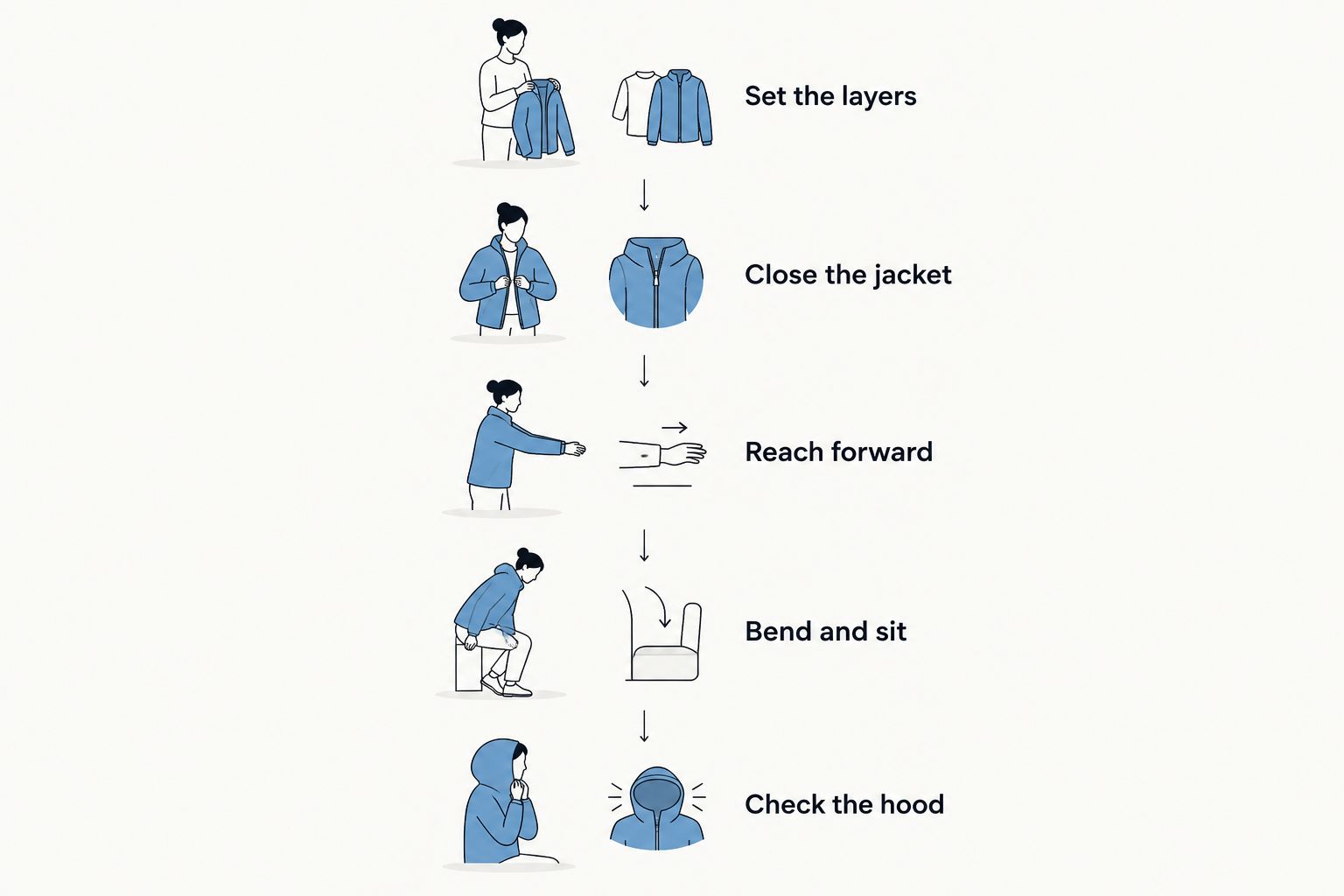
Run this sequence with the base layer, hoodie, and jacket you plan to wear. Test your real outfit, not a thinner substitute that makes the jacket feel better in the fitting room.
- Set the layers. Smooth the base layer, straighten the hoodie sleeves, and remove folds around the waistband. Do not begin with fabric already trapped under the jacket.
- Close the jacket. Fasten it normally. Stop if you need to brace your body or pull hard to bring the fronts together.
- Reach forward. Extend your arms as though holding a steering wheel, then reach across your body. Check for pressure across the upper back and underarms.
- Bend and sit. Bend your elbows and sit naturally. Notice whether cuffs pull sharply, the collar presses, or the hoodie gathers beneath the closure.
- Check the hood. Place the hood outside the jacket collar and turn your head. Finish by putting on the bag you actually carry.
The result should be clear. Comfortable movement means the pairing passes; persistent pressure means change a layer rather than keep rearranging it.
Read the folds before changing sizes
Folds are useful evidence. A ridge of hoodie fabric trapped inside the jacket sleeve suggests that the sleeve combination is crowded. A compressed roll at the waist suggests a conflict between garment lengths, waistbands, or overall volume.
Do not automatically size up everything. First straighten the layers and repeat the movement that caused the problem. If the restriction returns, change the garment responsible instead of creating extra fabric elsewhere.
How to choose a hoodie for the jacket you own
Start with your existing outer layer. Put the jacket on over your preferred hoodie and identify the limiting area before shopping. You need to know whether the problem is sleeve room, chest room, hood bulk, or length.
Rage U Athletics athletic apparel is for disciplined athletes who want their clothing to reflect that identity. The StarFall Hoodie is an individually numbered Phase 001: The Origin release. That design detail is a reason to consider the hoodie, not evidence that it fits beneath your jacket.
Keep the decision separate from the story. Check the garment's stated measurements and care instructions, then assess the full combination. A hoodie you like is still the wrong middle layer if your outer jacket compresses it or prevents normal movement.
Keep the base layer deliberate
A light, smooth base layer leaves more space for the hoodie. It also gives you a simpler outfit when you remove the outer layers indoors. Avoid adding another substantial garment underneath merely because each piece fits separately.
Your 2026 layering checklist should focus on the complete stack. Base layer, hoodie, and jacket must work together; the middle layer cannot fix a restrictive outer sleeve. Remove unnecessary bulk before replacing a garment you already wear comfortably.
Should you size up your jacket for a heavyweight hoodie?
Size up only if the larger jacket improves movement without creating a poor fit elsewhere. Compare the actual garments, not just their size labels. Check sleeve length, shoulder position, body volume, and how the jacket sits when closed.
A different cut is often the more direct option when the current jacket is narrow through the arms. Extra torso width alone does not solve that problem. Choose usable room, not a larger label.
Should the hood go inside or outside the jacket?
Start with the hood outside the jacket collar to keep it from bunching behind your neck. Spread the fabric evenly rather than leaving it folded into a lump. Turn your head and check that the neckline stays comfortable.
With a hooded jacket, assess the stacked hoods carefully. If they push against your neck or obstruct comfortable head movement, choose a hoodless outer layer or a different middle layer. Do not force the combination for appearance alone.
Can you train in a heavyweight hoodie and jacket?
Do not assume a comfortable streetwear combination is suitable for a workout. Exercise adds movement and heat that a standing fit check does not reproduce. Test the movements required by the activity and follow the clothing requirements of your training environment.
For the trip to training, the combination can be practical. For the session itself, select clothing for the activity rather than keeping every layer on to preserve the outfit. Remove a layer when the combination becomes uncomfortable.
FAQ
What's the best jacket fit for layering a heavyweight hoodie underneath?
A jacket with usable room through the chest, upper back, armholes, and sleeves is the best starting point. Close it over the hoodie and test reaching, bending, and sitting before deciding.
Does a heavyweight hoodie have to be oversized to work under a jacket?
No. A heavyweight hoodie needs a compatible cut, not an oversized label. Extra fabric can bunch inside a jacket that lacks sleeve or body space.
Can I wear a heavyweight hoodie under a denim jacket?
Yes, if the denim jacket accommodates the hoodie without restricting your shoulders or elbows. Test it closed, because an open front hides tightness across the chest.
Is a heavyweight hoodie waterproof under a jacket?
Layering does not establish waterproof protection. Check the outer jacket's stated weather protection rather than treating the hoodie as rainwear.
Can I choose a Rage U Athletics hoodie for everyday layering?
You can consider a Rage U Athletics hoodie for everyday layering, but jacket compatibility depends on the actual garments. Check measurements and test the full outfit rather than assuming the brand name determines fit.
What should I check before buying a layering jacket in 2026?
Check the jacket over the hoodie you intend to wear in 2026. Confirm comfortable closure, free shoulder and elbow movement, and enough neck room for the hood.
One last thing
Bring your hoodie when you try on the jacket. It is more useful than guessing how much extra room you need. Wear your usual base layer and carry your usual bag, too.
Then sit down before deciding. A pairing that looks right standing up can fail across the back, at the waist, or behind the neck. Buy for the day you actually have.