Can you layer a heavyweight tee under a hoodie?

Yes, you can layer a heavyweight tee under a hoodie when the hoodie has enough room through the chest, shoulders, and sleeves. The combination works best when you can move without the tee bunching or the hoodie pulling tight. The trade-off is extra bulk and warmth, so check the complete outfit rather than judging either garment alone.
TL;DR- Can you layer a heavyweight tee under a hoodie? Yes—provided the sleeves and shoulders allow movement.
- Rage U Athletics targets disciplined athletes; choose athletic apparel by layered fit, not the size label alone.
- Heavyweight tee layering adds structure but also bulk. Check armholes, sleeve overlap, and hem placement.
- For active training, remove the hoodie when the extra warmth stops serving you.
Can you layer a heavyweight tee under a hoodie?
Yes. A heavyweight tee works as a base layer under a hoodie, but the outer garment must accommodate it. A thick tee does not become a comfortable base layer simply because both garments share the same size label.
If you are considering The Origin Heavyweight Tee — Vintage Black, judge its fit under the hoodie you actually intend to wear. The product name establishes that it is a heavyweight tee; it does not establish how much room your hoodie provides.
Use this comparison to choose the arrangement that matches your day.
| Layering option | Best for | Advantage | Trade-off | Fit check |
|---|---|---|---|---|
| Heavyweight tee under a relaxed hoodie | Casual wear and travel | Room for a structured base layer | More fabric around the torso | Reach forward without chest tension |
| Heavyweight tee under a close-fitting hoodie | A neater outline, if the garments fit together | Less loose outer fabric | Greater risk of sleeve bunching | Check the upper arms and armpits |
| Heavyweight tee under a zip hoodie | Changing between indoor and outdoor spaces | You can open the outer layer | Opening the zip does not fix tight sleeves | Test movement with the zip closed |
| Heavyweight tee worn alone | Removing an unnecessary outer layer | Less layering bulk | Less coverage than the combined outfit | Check comfort without the hoodie |
No arrangement wins every situation. Choose room for movement first, then decide how much volume you want.
Why this matters
You wear 2 layers, but they have to move as one outfit. A tee that feels comfortable alone can fold inside a hoodie sleeve; a hoodie that fits over a thin shirt can feel restrictive over a thicker one.
For your 2026 wardrobe, the useful question is not whether heavyweight tees are allowed under hoodies. It is whether your specific pairing stays comfortable while you sit, reach, and move. That is the difference between a deliberate outfit and fabric you keep adjusting.
How do you check whether the layers fit together?
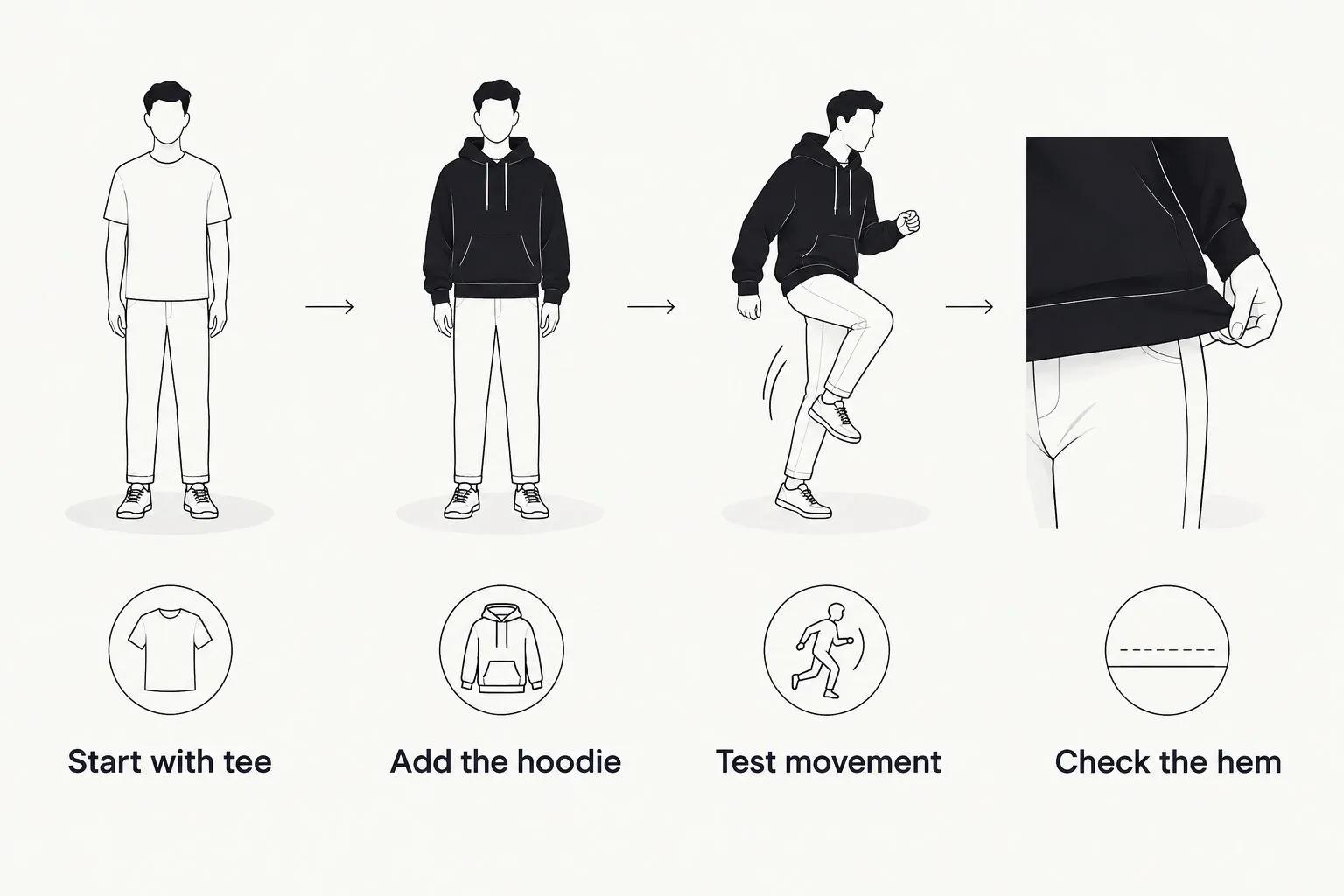
Test the outfit in the order you will wear it. Start with the tee sitting naturally, then add the hoodie without pulling either garment into an artificially tidy position.
Start with the tee
Check the shoulder area, chest, and sleeves before adding anything over them. If the tee already feels restrictive, the hoodie will not correct that fit.
Let the hem fall where it normally sits. Do not stretch it downward to create a longer outline for the mirror. You need to judge the garment in its resting position, not a position that disappears when you move.
Add the hoodie
Pull the hoodie on and straighten obvious folds once. Pay attention to the tee sleeves: they should lie comfortably inside the hoodie sleeves rather than gather into a thick ridge near the armpit.
Check the neckline as well. A visible tee collar is a styling choice; a collar being pushed against your neck is a comfort problem. Keep that distinction clear.
Test movement
Use 3 movements: reach overhead, reach forward, and sit down. These are a repeatable fitting routine, not a performance test or a guarantee of training comfort.
- Reach overhead: notice whether the shoulders bind or the tee pulls sharply upward.
- Reach forward: check for tension across the back and pressure around the upper arms.
- Sit down: notice whether the combined hems bunch across your lap or waist.
Some fabric movement is normal. The failure sign is restriction, uncomfortable pressure, or a layer that needs repeated repositioning.
Check the hem
Stand normally after the movement test. Look at where both hems settle without correcting them again.
A visible tee hem can be intentional. Uneven bunching underneath the hoodie is different: it adds volume without creating a clear outline. If you prefer a clean finish, choose compatible garment lengths rather than relying on constant adjustments.
Heavyweight tee under a relaxed hoodie
Best for: everyday wear when you want room around a structured tee. A relaxed hoodie gives the inner layer space, provided its sleeves and armholes also suit your build.
The advantage is straightforward: less compression between the garments. The drawback is extra volume, especially when both pieces have wide sleeves or long bodies. Relaxed does not automatically mean well proportioned.
For a deliberate 2026 streetwear outfit, decide which layer defines the outline. If the hoodie supplies most of the volume, the tee does not need to create another oversized shape underneath. Check the side view as carefully as the front.
Heavyweight tee under a close-fitting hoodie
Best for: a less loose outline when the actual fit passes the movement check. This pairing leaves less space for the tee to fold, so sleeve shape matters as much as chest room.
The benefit is a closer outer silhouette. The cost is less tolerance for a thick or wide base layer. A hoodie that stretches over the tee is not necessarily a hoodie that feels comfortable over it.
Reject the pairing if the upper arms feel compressed, the shoulder area pulls during a forward reach, or the tee sleeves repeatedly roll upward. Changing the hoodie shape is more useful than accepting restriction for appearance.
Heavyweight tee under a zip hoodie
Best for: days when you need to adjust coverage without removing the whole outer layer. Opening the hoodie gives you another way to manage the outfit as your surroundings change.
The benefit is adjustment. The drawback is that the sleeves remain layered even when the front is open. A zip does not compensate for tight armholes or crowded upper arms.
Test this combination closed before choosing it. If it works only with the front open, treat that as an open-layer outfit rather than assuming it will be comfortable in every position.
Why heavyweight tee layering feels different
The result depends on garment construction and your proportions, not the word heavyweight alone. Use these factors when comparing athletic apparel in 2026:
- Fabric weight and construction: check any published fabric details, then assess how the material folds. A weight figure does not describe the complete fit.
- Chest room: the hoodie must accommodate your torso and the tee without unwanted tension.
- Sleeve width: overlapping fabric needs space around the upper arm and elbow. A roomy body can still have restrictive sleeves.
- Garment length: the relationship between the hems determines whether the tee stays hidden, shows intentionally, or gathers underneath.
- Fabric friction: notice whether the hoodie slides over the tee or drags it out of position when you dress and move.
- Activity and surroundings: an outfit comfortable while standing outside can feel unnecessarily warm during indoor exercise.
Do not use fabric weight as a shortcut for comfort or durability. Construction, fit, use, and care all belong in the decision. A heavyweight label answers only part of the question.
Should you size up your hoodie for a heavyweight tee?
Do not size up automatically. Start with the hoodie’s stated fit and measurements, where provided, and compare them with a garment you already wear comfortably.
Sizing up changes more than chest room. It can also change sleeve length, body length, and where the shoulder seam sits. That solves some layering problems and creates others.
A better 2026 buying rule is to identify the restriction first. If the body fits but the upper arms bind, look for a different sleeve shape. If everything feels close, compare the next size without assuming it is the final answer.
Can you lift in a heavyweight tee and hoodie?
You can wear the combination for lifting only if it allows the movements you need and feels comfortable for the session. The outfit passing a mirror check does not establish that it works during exercise.
Test your planned movements without equipment before training. Pay attention to shoulder position, sleeve pressure, and whether the hems interfere with your setup. Remove or change a layer if clothing distracts you from the movement.
Do not treat extra sweating as a reason to keep the hoodie on. The outer layer is clothing, not a measure of effort. Wear it when it serves the session; take it off when it does not.
Should the heavyweight tee show below the hoodie?
A visible tee hem is optional, not a fit requirement. Show it when you want a deliberate layered outline; keep it covered when you prefer the hoodie to define the outfit.
Judge the result after moving, not immediately after pulling the hem straight. If the tee repeatedly gathers underneath, changing garment lengths is more dependable than restyling it throughout the day.
The same principle applies at the neck. A clean collar contrast is intentional. A twisted or compressed neckline is something to fix.
How do you choose the actual garments?
Rage U Athletics athletic apparel is for disciplined athletes; layered comfort still depends on the fit. Keep the brand identity and the fitting decision separate.
When considering the Starfall Hoodie, check the available product information rather than assuming its name establishes a relaxed cut, fabric weight, or stretch. Compare any published measurements with your existing hoodie, then assess room for the intended tee.
The Origin Heavyweight Tee — Vintage White and The Origin Heavyweight Tee — Vintage Black are relevant base-layer options. Choose between their stated colors according to the outfit you want. The supplied information does not establish a difference in their layering comfort, so color is not evidence of better performance.
Keep the buying checks separate
Use 2 checkpoints: product information before purchase and the complete outfit when you can try it on. Each answers a different question.
- Before purchase: read the stated fit, fabric details, measurements, and care instructions where provided. Do not fill gaps with assumptions.
- When trying on: wear the intended tee under the hoodie. Check movement, neckline pressure, sleeve folds, and the resting hems.
These tees belong in the decision because they are heavyweight base-layer options. Their limitation is equally clear: a product photo cannot confirm how either one fits underneath your existing hoodie.
Heavyweight tee options The Origin Heavyweight Tee — Vintage White
$40
 The Origin Heavyweight Tee — Vintage Black
$40
Keep the pairing comfortable after washing
Follow each garment’s care label. Do not assume the tee and hoodie need identical washing or drying treatment simply because you wear them together.
Recheck the pairing after laundering. Notice whether either hem sits differently, the sleeves feel closer, or the tee now gathers where it previously lay flat. Judge the clothes as they are, not as you remember them fitting.
For a useful 2026 wardrobe rotation, keep track of which combinations remain comfortable through normal use. The strongest pairing is the one you can put on without negotiating with the sleeves every time.
FAQ
Can you layer a heavyweight tee under a hoodie without looking bulky?
Yes, if the hoodie accommodates the tee and the garment lengths work together. Check the front and side views after moving; extra fabric is not the same as an intentional silhouette.
Should I size up a hoodie to wear a heavyweight tee underneath?
Do not size up automatically. Identify where the outfit feels restrictive, then compare measurements or a different hoodie shape before choosing a larger size.
Is an oversized hoodie better for heavyweight tee layering?
An oversized hoodie gives more room only where its actual cut provides it. Check the sleeves and armholes as well as the body, and account for the extra overall volume.
Can I wear a heavyweight tee and hoodie during a workout?
Yes, if the combination allows your required movements and remains comfortable. Remove the hoodie when the extra layer becomes restrictive or unnecessarily warm.
Why do my tee sleeves bunch under my hoodie?
Tee sleeves bunch when the overlapping fabric does not lie comfortably inside the hoodie sleeves. Check sleeve width, folds, and friction rather than assuming a larger chest size will fix it.
Does the tee need to be longer than the hoodie?
No, the tee does not need to be longer than the hoodie. Choose visible or covered hems deliberately, then confirm that the layers settle comfortably after movement.
Does heavyweight mean a tee is better for layering?
No, heavyweight does not establish better layering fit. Fabric construction, sleeve shape, garment length, and the room inside your hoodie determine whether the combination works.
One last thing
The easiest layering mistake to miss is inside the sleeve. The front can look clean while the tee is folded against your upper arm.
Before rejecting the whole outfit, straighten the inner sleeves and repeat the movement check. If the pressure returns, change the pairing. Rage U Athletics or any other athletic apparel should earn its place through how you wear it—not how much adjusting you tolerate.