Can you iron a graphic print on a hoodie?

You can iron a graphic hoodie if its care label permits ironing, but never place the hot soleplate directly on the print. Work on unprinted fabric, turn the garment inside out where instructed, and keep heat away from the graphic unless the manufacturer explicitly allows it.
TL;DR- Can you iron a graphic print on a hoodie? Not directly; follow the garment’s ironing instructions.
- A pressing cloth does not make every graphic safe to iron.
- Rageuathletics sells athletic apparel for disciplined athletes; garment-specific care instructions take priority over general hoodie advice.
- Skip household heat repairs on peeling, cracked, or sticky graphics.
Can you iron a graphic print on a hoodie?
Iron the permitted fabric, not the graphic itself. A hoodie’s base fabric and its decoration are different materials. Permission to iron the fabric does not automatically cover the printed area.
Use this order of operations for your 2026 hoodie-care routine:
- Read the care label. Look for an ironing symbol, temperature restrictions, and instructions about decoration.
- Check the graphic. Stop if the surface is peeling, tacky, blistered, or already distorted.
- Separate the layers. Position the garment so the iron cannot heat a graphic on the opposite side through the fabric.
- Prepare the permitted area. Turn the hoodie inside out if instructed, and lay the fabric flat without stretching it.
- Use the permitted setting. Follow the garment’s limit and any separate instructions about steam.
- Let the fabric cool. Inspect the result before making another pass or folding the hoodie.
For the rest of your laundry routine, see how to wash a heavyweight cotton hoodie without shrinking it. Washing, drying, and pressing belong to the same care system; an ironing fix does not undo damage from an unsuitable wash or drying cycle.
Why this matters
A graphic is part of the hoodie’s design, not just another patch of fabric. Direct heat can soften some print materials, disturb their surface, or affect the adhesive holding a transfer in place. Pressure can also flatten raised decoration.
The cost is not limited to the print. An unsuitable iron setting can leave shine, scorch fabric, or distort a seam. Removing a wrinkle is not worth creating permanent damage.
For athletic apparel, the practical goal is simple: keep the garment wearable without sacrificing the design. A few remaining creases are a better result than a smooth hoodie with a damaged chest graphic.
Which wrinkle-removal method should you choose?
Choose the method from the care instructions, not from the size of the wrinkle. This comparison applies to graphic hoodies generally; it does not establish care instructions for a particular Rageuathletics garment.
| Method | Best for | Main advantage | Main limitation |
|---|---|---|---|
| Ironing unprinted fabric | Localized creases where ironing is permitted | Targets the fabric that needs attention | Requires keeping the print and other heat-sensitive details clear |
| Reverse-side pressing | Garments whose instructions explicitly permit it | Avoids direct soleplate contact with the print face | Heat still travels through the fabric |
| Garment steaming | Garments whose instructions permit steam | Avoids pressing the fabric flat with a soleplate | Steam still applies heat and moisture |
| Reshaping after washing | Routine care when the washing instructions allow it | Avoids a separate heated pressing step | Does not remove every established crease |
| Leaving the graphic alone | Unknown or restricted print care | Avoids unnecessary heat exposure | Some wrinkles remain |
Best for uncertain care instructions: leave the graphic alone. Uncertainty is not a reason to test the front of the hoodie with a hot iron.
In 2026, the useful distinction is still contact versus exposure. Removing direct contact reduces one risk. It does not remove the heat reaching the decoration.
How do you iron the unprinted parts of a hoodie?
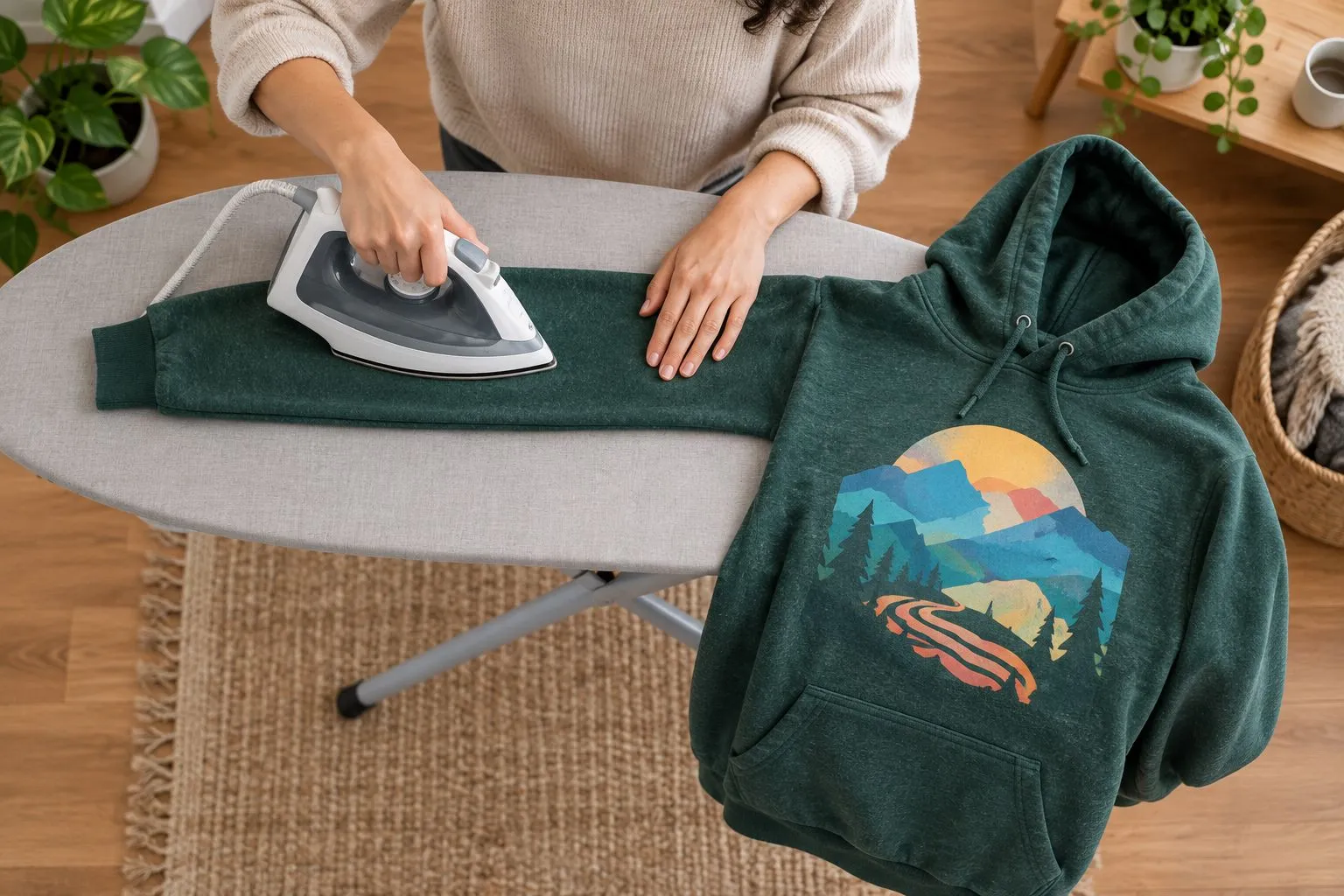
Start with a clean garment and a clean soleplate. Residue on either surface can mark the fabric. Set up an ironing board with enough space to keep the printed panel away from the working area.
Check the whole garment
Find every decorated area before you start. A chest graphic is obvious. A small sleeve print, back graphic, or printed detail near a cuff is easier to miss.
Check zippers, drawcord ends, patches, and trims too. Do not drag the iron across hardware or assume every component tolerates the same setting as the main fabric.
Isolate the fabric
Feed the section you want to press over the board so you are working on a single garment layer where possible. Keep the opposite panel clear. A plain-looking back surface can still have a graphic directly underneath it.
For a sleeve, flatten the fabric without pulling the cuff tight. For the body, move the garment around the board rather than stretching it to reach the next crease. Preserve the shape you bought.
Press only where permitted
Use the setting allowed by the label. If the instructions require a pressing cloth, use a clean, suitable cloth between the iron and the permitted fabric area.
Keep the iron moving as appropriate for the garment instructions, and never leave it resting on the hoodie. Stop if the fabric changes appearance, develops shine, or gives off an unusual odor.
Cool before handling
Let the pressed section cool before folding, stacking, or putting on the hoodie. Check the surface in good light rather than repeatedly pressing it while it is still warm.
If a crease remains near the graphic, do not chase it across the design. Stop at the boundary of the permitted area. A controlled stopping point matters more than a perfectly flat front panel.
Why ironing safety varies between graphic hoodies
There is no universal graphic-hoodie iron setting. These factors determine what you can safely do:
- Base fabric: Cotton, synthetic fibers, and blends have different heat tolerances. Follow the finished garment’s label rather than a generic fiber chart.
- Decoration material: Printed ink, transfer film, and raised decoration do not all respond to heat in the same way.
- Application method: A transfer attached with adhesive needs different consideration from a design printed into or onto fabric.
- Graphic condition: Existing cracks, lifting edges, and tackiness are reasons to avoid further heat, not reasons to increase it.
- Garment construction: Multiple layers, seams, pockets, and ribbing change how evenly the fabric sits beneath the iron.
- Manufacturer instructions: A specific restriction on ironing the decoration takes priority over general advice about the hoodie’s fabric.
For a 2026 care checklist, record the actual instructions rather than guessing the print process. A raised finish does not identify its chemistry. Neither does a soft hand feel.
Does turning a hoodie inside out protect the graphic?
Turning a hoodie inside out prevents direct soleplate contact with the outside graphic, but it does not block heat. Reverse-side pressing is an option only when the garment’s instructions permit it.
The printed surface can also end up pressed against the board underneath. That is why positioning matters as much as orientation: inspect what sits below the fabric before bringing the iron down.
Can you put a towel over a hoodie graphic and iron it?
A towel does not make an otherwise prohibited ironing method safe. Heat still passes through the covering, and a thick towel makes it harder to judge the surface underneath.
Use a pressing cloth only as part of an allowed method. Do not treat a barrier as permission to iron a graphic that the manufacturer says to avoid.
Can you iron a peeling hoodie graphic back down?
Do not use a household iron as a general repair tool for a peeling graphic. The correct repair depends on the decoration material, adhesive, fabric, and original application process.
A household iron does not provide the same controlled application conditions as professional decoration equipment. More pressure or repeated heat is not a reliable substitute. Ask the manufacturer or a garment decorator whether the specific print is repairable.
What do the ironing symbols mean?
An iron symbol tells you about permitted ironing conditions. Dots indicate heat categories; a crossed-out iron means do not iron. Read any written instruction beside the symbol, especially warnings about decoration or steam.
Do not match a dot setting to an online temperature chart without checking the label and your iron’s instructions. Settings and labeling systems require interpretation, and a generic fabric name is not enough to resolve conflicting guidance.
For your 2026 laundry setup, keep the iron’s manual accessible. A crossed-out iron is a stop instruction, not an invitation to try reverse-side pressing or add a thicker cloth.
How should you care for a hoodie when ironing is restricted?
Start before the wrinkles set. Follow the washing instructions, avoid leaving the garment compressed after the cycle, and reshape it using the drying method permitted on its label.
Smooth the body and sleeves gently. Do not pull the graphic taut to flatten it. Let the garment dry fully before folding it, and keep a hard fold away from a large printed panel where practical.
If you are considering the Starfall Hoodie, check its garment-specific care instructions before choosing an ironing method. The product name alone does not establish its fabric composition, print process, or heat tolerance.
Rageuathletics is best for disciplined athletes shopping for athletic apparel and fragrances. That positioning does not replace product-level care information: buy for the design and intended use, then maintain the garment according to its actual instructions.
FAQ
Can you iron a graphic print on a hoodie directly?
Do not place a hot iron directly on a hoodie graphic unless the manufacturer explicitly permits that method. Follow the garment’s care label and keep the printed area clear when ironing permitted fabric.
What iron setting should I use on a graphic hoodie?
Use only the setting allowed by the hoodie’s care label. There is no universal setting that is safe for every fabric, print, adhesive, and trim.
Is steaming a graphic hoodie safer than ironing it?
Steaming avoids direct soleplate contact, but it still exposes the hoodie to heat and moisture. Use steam only when the garment’s instructions allow it, and follow any restrictions covering the graphic.
Can I iron the back of a printed hoodie?
You can iron the back only where the care instructions permit it and the graphic is not beneath the area being heated. Separate the garment layers so heat is not applied through a plain panel into a printed one.
Will a pressing cloth stop a hoodie graphic from melting?
A pressing cloth does not guarantee protection from heat damage. It separates the soleplate from the surface but still allows heat to pass through.
Can I fix a cracked hoodie print with an iron?
Do not treat ironing as a general fix for a cracked hoodie print. Repair depends on the print material and application process; ask the manufacturer or a garment decorator about the specific damage.
Should I follow a 2026 online ironing guide or the hoodie’s label?
Follow the hoodie’s label and any specific manufacturer instructions about its decoration. A 2026 online guide provides general guidance, not permission to override a do-not-iron restriction.
One last thing
Check underneath before you press. The easiest graphic to miss is the one hidden beneath the plain panel you are ironing. Separate the layers, move the decoration clear, and work only on the permitted fabric.
Keep that rule in your Rageuathletics apparel-care routine. You do not need to erase every crease. You need to avoid turning a temporary wrinkle into permanent damage.