Can heavyweight sweatpants be tailored for a slimmer leg?

Yes, heavyweight sweatpants can be tailored slimmer when the seams, pockets, cuffs, and graphics leave room for a clean taper. For a 2026 alteration, preserve space through the seat and thighs, test the proposed shape while moving, and approve the fit before the tailor cuts away fabric; a narrower leg also changes how easily the pants pass over your heel.
TL;DR- Can heavyweight sweatpants be tailored slimmer? Yes, provided the construction supports a taper without restricting movement.
- Keep thigh and knee room. Remove excess width where it actually sits, rather than narrowing the whole leg.
- For Rage U Athletics athletic apparel, inspect the individual garment before choosing an alteration.
- Approve a temporary fitting before cutting. Removed fabric is not easily restored.
Why this matters
A slimmer outline is useful only if the pants still work when you sit, climb stairs, and bend your knees. Heavy fabric makes a poor alteration obvious: bulky seams, twisting legs, and tight calves interrupt the shape you wanted to improve.
For your 2026 wardrobe, separate the look from the function. You can want a cleaner ankle without wanting a tight thigh. Start with how a hoodie and sweatpants set should fit for workouts, then decide which part of your current pair needs changing.
Tailor the excess, not the movement room. A taper should solve a specific fit problem, not turn relaxed sweatpants into compression clothing.
Can heavyweight sweatpants be tailored for a slimmer leg?
Yes. A tailor can narrow the leg by reshaping an existing seam, provided the garment's construction allows it. The right approach depends on where the excess starts and what the seam intersects.
Use this sequence before committing:
- Identify whether the excess sits at the thigh, knee, calf, or ankle.
- Have the tailor inspect the seams, pocket bags, cuffs, and decoration.
- Fit the proposed taper temporarily, then test movement before cutting.
These alteration options solve different problems. None is automatically the right choice for every pair.
| Alteration | Best for | Advantage | Trade-off |
|---|---|---|---|
| Lower-leg taper | A loose calf with a comfortable thigh | Preserves more upper-leg room | A narrow opening can catch at the heel |
| Full-leg taper | Excess width through both thigh and calf | Changes the overall silhouette | Pockets and knee room need closer attention |
| Hem shortening | Excess length rather than excess width | Removes unwanted stacking | Does not narrow the leg |
| Cuff adjustment | An ankle opening that needs reshaping | Targets the finish at the ankle | Cuff removal and reattachment add work |
Choose the smallest alteration that fixes the problem. If the seat already pulls or the waistband sits incorrectly, narrowing the calf will not correct those issues.
Lower-leg taper: keep the thigh room
A lower-leg taper suits sweatpants that fit through the seat and thighs but look loose below the knee. The tailor blends the existing leg shape into a narrower lower section rather than taking the same amount from top to bottom.
The benefit is restraint. You keep room where your legs need it and reduce fabric where it gathers around the calf or shoe. The limitation is the ankle opening: a cleaner outline still needs enough clearance for dressing and walking.
Ask the tailor to check the transition around the knee. An abrupt change creates a visible pinch instead of a continuous line. If the calf grips when you bend your knee, ask for more room before approving the seam.
Full-leg taper: check the pockets first
A full-leg taper addresses excess width above and below the knee. It changes more of the original cut, so it needs a closer fitting than an ankle-only adjustment.
Pocket construction matters here. Narrowing a side seam can interfere with a pocket opening or pocket bag. Moving the alteration to another seam is not an automatic solution; the tailor still needs to preserve the leg's balance.
The advantage is a more consistent reduction through the leg. The disadvantage is that each change affects surrounding areas. A slimmer thigh can pull across the seat when you sit, even if the pants look clean while standing.
Approve the seated fit, not just the mirror fit. Do not accept pulling as the price of a sharper outline.
Cuff adjustment: preserve the opening
Cuffed sweatpants need separate decisions about leg width and ankle finish. Narrowing the fabric above a cuff does not necessarily make the cuff itself smaller.
The tailor should assess whether the existing cuff can be retained, reshaped, or reattached neatly. A bulky join can undermine an otherwise clean taper. A narrow join can also make the opening difficult to pull over your heel.
Cuff work is best for an ankle-specific problem, not a substitute for correcting excess fabric higher up. If the pants bunch because they are too long, discuss length before narrowing anything. Shortening and tapering are different jobs, even when the finished result includes both.
Why tailoring results vary
The fabric's weight is only part of the job. Construction determines where an alteration can happen and what it will disturb.
- Fabric stretch: A knit with limited stretch needs enough room in the finished garment for movement. Do not rely on the fabric stretching to rescue an overly tight taper.
- Seam construction: Existing stitch lines, seam allowances, and finishing determine how the new seam can be made and enclosed.
- Pocket placement: A pocket that reaches into the alteration area limits how straightforward the job will be.
- Graphics and embroidery: Decoration near a seam can shift, disappear into the seam, or lose its intended placement when the leg narrows.
- Cuff construction: Ribbing, elastic, and the attachment seam require inspection before changing the opening.
- Your intended use: Sweatpants for sitting and walking have different practical demands from pants you expect to squat or lunge in.
Bring the actual garment. A photograph can show the silhouette you want, but it cannot show every internal seam or how the fabric behaves on your body.
How to brief your tailor in 2026
Arrive with a fit goal, not a demand to remove an arbitrary amount of fabric. A reference pair helps explain the shape, but different fabrics will not necessarily drape identically.
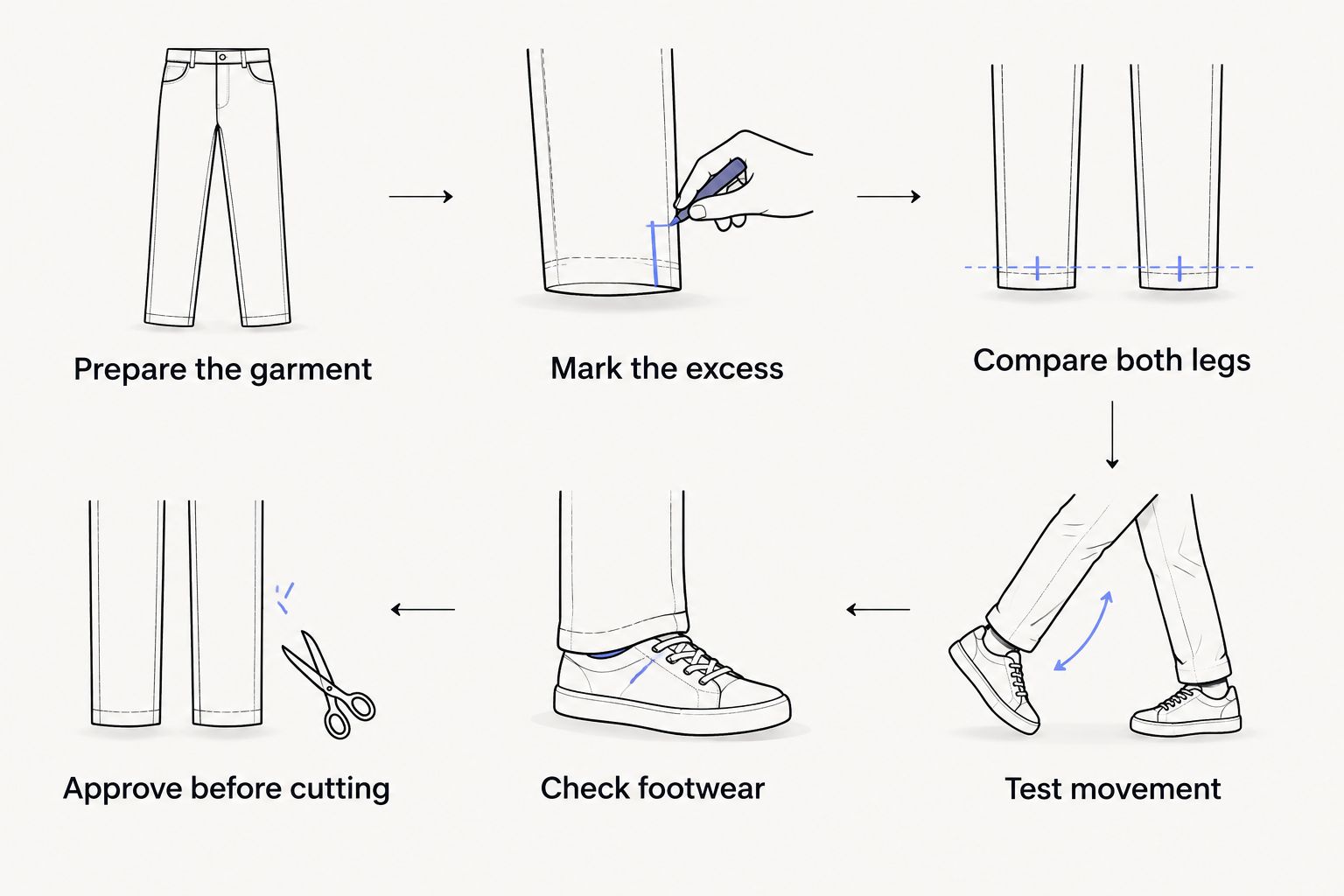
Prepare the garment
Clean the sweatpants according to their care label before the fitting. Present them in the condition you normally wear them, with pockets empty. Tell the tailor whether you want them for training, recovery days, or everyday streetwear.
Mark the excess
Point to the exact problem: loose calves, a wide ankle, excess thigh fabric, or too much stacking. Ask the tailor to mark the proposed seam while the pants sit at your normal waistband position.
Compare both legs
Check both legs from the front, side, and back. Compare the proposed shape around the knees and ankles. Do not assume an adjustment looks balanced just because the marked seam appears straight on a table.
Test movement
Ask for a safely basted fitting when needed; do not perform movement tests with exposed pins. As a practical fitting routine, complete 3 bodyweight squats, 2 lunges per side, and a 30-second seated hold. These are checks, not a sizing standard.
Check footwear
Wear the shoes you expect to use with the pants. Check where the hem lands and whether the opening catches as you walk. Then confirm you can take the pants off without forcing the cuff over your heel.
Approve before cutting
Confirm the finished outline, length, and opening before excess fabric is removed. Ask how the new seam will be finished and whether the original allowance can be retained without uncomfortable bulk. Keep the brief specific: cleaner calf, unchanged thigh, usable pockets.
How much slimmer should you make heavyweight sweatpants?
There is no universal amount to remove. Your starting fit, fabric stretch, calf shape, and intended movement determine the usable reduction. A measurement copied from someone else's pants is not a fitting plan.
Ask for a visible improvement without pressure at the knee or calf. The fabric should follow your leg without pulling the waistband down when you sit. Check whether the pockets stay flat and whether the leg returns to place after bending.
Measure the approved garment if you want a record for later alterations. Keep the measurement method consistent: flat width and full circumference are different measurements. Write down where each measurement was taken rather than recording an unexplained number.
Will a slimmer leg restrict squats or lunges?
A slimmer leg restricts movement when the alteration removes room your knees, thighs, or seat need. Fabric weight alone does not tell you how much room to preserve. The fitting does.
Watch for fabric pulling across the knees, pockets opening under tension, or the waistband shifting as you lower yourself. Stop and revise the taper if these appear. Do not plan to break in an alteration that already feels restrictive.
For your 2026 fitting, repeat the same movement checks before and after the temporary seam is adjusted. That comparison gives you a clearer decision than standing still and asking whether the pants look slim enough.
Should you shrink sweatpants instead of tailoring them?
Do not use deliberate shrinking as a substitute for a controlled taper. Washing and drying affect the garment as a whole, not just the loose section of the leg. You cannot direct shrinkage only to the calves while preserving the rise and length.
Follow the care label. If the pants have graphics, elastic, or other trim, their care requirements matter alongside the main fabric.
Tailoring lets you identify and reshape a particular area. Its disadvantage is that cutting removes material you might later want back. Shrinking is less targeted; tailoring is more deliberate. Neither approach repairs a fundamentally unsuitable starting fit.
Keep the design when you change the fit
Rage U Athletics athletic apparel is best for disciplined athletes seeking a training-focused identity. The alteration should preserve the design you chose, not just reduce its width.
If you are considering the StarFall Sweatpants, have a tailor inspect the actual pair before planning a taper. The supplied product description identifies an individually numbered release; that does not establish its seam layout, fabric stretch, or suitability for a particular alteration.
For a 2026 alteration brief, point out any numbering, graphics, or embroidery you want preserved. Tell the tailor which details are non-negotiable. Keep the original fit if achieving a narrower leg would cut through a feature you value.
FAQ
Can heavyweight sweatpants be tailored slimmer without changing the waist?
Yes, a leg taper can leave the waistband unchanged when the construction allows it. The tailor still needs to check how the revised leg affects the seat, pockets, and movement.
Can a tailor make baggy sweatpants into slim joggers?
A tailor can narrow baggy sweatpants, but a taper does not automatically reproduce a different jogger pattern. The original rise, pocket placement, cuffs, and fabric limit the result.
Is it better to taper sweatpants from the inseam or the outside seam?
The appropriate seam depends on the garment's construction and the shape you need. Ask the tailor to assess pocket interference, decoration, and leg balance before choosing.
Can graphic sweatpants be tapered without damaging the print?
Graphic sweatpants can be tapered without cutting the print when the decoration sits clear of the alteration area. Graphics near a seam need individual assessment because narrowing changes their relationship to the finished leg.
Should heavyweight sweatpants be washed before tailoring?
Yes, clean heavyweight sweatpants according to their care label before the fitting. Fit the garment in its normal wearing condition rather than deliberately shrinking it first.
Can I make my sweatpants wider again after tapering?
Widening tapered sweatpants depends on how much usable seam allowance remains. Once excess fabric is cut away, the original width is not necessarily recoverable.
Do I need to shorten sweatpants when I taper them?
No, tapering and shortening solve different fit problems. Check the length with your normal shoes before deciding whether the pants need both alterations.
One last thing
The baggy section you notice at the ankle is not always an ankle-width problem. Excess length can collect above a cuff and make the lower leg look wider than it is.
Before approving your 2026 taper, ask the tailor to show the proposed length and width separately. You might prefer the original width once the hem sits correctly. With Rage U Athletics or any other sweatpants, change one fit variable at a time during the fitting. That keeps a simple correction from becoming an unnecessary rebuild.