Can a gym hoodie be worn in hot weather?

Yes, you can wear a gym hoodie in hot weather for low-effort use or inside a cooled gym, provided you stay comfortable and can remove it. For hard training in heat, leave the hoodie off: extra coverage and insulation can restrict heat loss, and sweating more does not mean burning more fat.
TL;DR- Can a gym hoodie be worn in hot weather? Yes for cooler indoor settings; skip it for hard outdoor training.
- Dense fleece adds insulation; a loose fit alone does not make a hoodie suitable for heat.
- Rage U Athletics athletic apparel suits discipline-focused athletes; choose workout layers by conditions, not identity.
- Remove unnecessary layers before discomfort becomes dizziness, headache, nausea, or unusual weakness.
Can a gym hoodie be worn in hot weather?
A gym hoodie works in hot weather only when the setting and effort make the extra layer comfortable. An air-conditioned weight room is different from an outdoor conditioning session. The temperature outside does not describe both environments.
Use this comparison before you dress. For the broader choice between hooded and hoodless layers, read hoodies versus sweatshirts for gym workouts.
| Clothing option | Best for | Main advantage | Main drawback | Recommendation |
|---|---|---|---|---|
| Lightweight, loose hoodie | Low-effort movement in comfortable conditions | Coverage without the bulk of dense fleece | Still adds coverage and can become uncomfortable as effort rises | Keep it removable |
| Dense fleece hoodie | Cool indoor spaces or cooler conditions | Insulation when you need warmth | Adds unwanted insulation during hot exercise | Skip for hard training in heat |
| Lightweight training top | Active training in hot conditions | Less coverage and bulk than a hoodie | Less coverage when you move into cold air conditioning | Choose for the workout |
The 2026 summer training rule: dress for the hardest part of the session, not just the walk into the gym. Carrying an extra layer is different from committing to wear it through every set.
Why this matters
Exercise produces heat. Your body sheds that heat through several routes, including sweat evaporation. Clothing changes the conditions around your skin, so an outfit that feels fine while standing still can become uncomfortable once training starts.
Visible sweat is not a cooling score. Sweat dripping onto the floor has not provided the same cooling benefit as sweat that evaporates. Humidity also makes evaporation harder.
You do not need to prove discipline through clothing discomfort. Choose an outfit that lets you complete the planned work without adding an avoidable heat burden. That principle applies to lifting, conditioning, and the trip home.
Lightweight hoodies: useful coverage, not automatic cooling
A lightweight hoodie can make sense when you want a layer for a cooled building or a relaxed walk. The useful feature is that you can remove it when conditions change. A zipper adds an opening, but it does not cancel the insulation of the fabric.
Look beyond the word lightweight. Check whether the inside is smooth or heavily brushed, whether the fabric feels dense, and whether the garment lets you move without clinging or binding. These details describe the garment more clearly than a seasonal label.
The trade-off remains simple: you get coverage, but you also cover skin that would otherwise be exposed to moving air. Do not treat a thin hoodie as permission to ignore heat, humidity, or exertion.
Best for: comfortable, low-effort use where you can change layers. Skip it when the hoodie already feels hot before training begins.
Dense fleece hoodies: keep the warmth for cooler conditions
Dense fleece has a clear job: insulation. That makes it useful when you want warmth, not when you are trying to shed exercise heat. A roomy cut does not remove that trade-off.
Brushed fabric can trap insulating air within its structure. Fabric thickness, construction, and the layers underneath all matter. An oversized hoodie over a substantial tee still puts multiple layers between your skin and the surrounding air.
Keep the distinction between training clothes and arrival clothes. Wearing fleece to a gym with strong air conditioning is not the same decision as keeping it on during outdoor intervals.
Best for: cool spaces and cooler conditions. Skip dense fleece for hard exercise in hot weather. If you like the silhouette, wear it outside the demanding part of the session rather than forcing it through the workout.
Why hoodie comfort varies in hot weather
There is no universal outdoor temperature that makes every hoodie comfortable or unsafe. Your effort, surroundings, and clothing work together. Judge the whole setup rather than looking for a single cutoff.
- Fabric construction: thickness, density, and a brushed interior affect insulation. Fiber names alone do not describe the finished garment.
- Fit and openings: room around the torso, open cuffs, and a front opening affect how clothing sits and ventilates. Loose does not automatically mean cool.
- Humidity and airflow: humid, still conditions make evaporative cooling harder. A fan-cooled room is a different setting from a sheltered outdoor court.
- Sun exposure: direct sun adds heat load. The National Weather Service notes that full sunshine can increase heat-index values by up to 15°F compared with shaded conditions.
- Exercise intensity: standing between lifts and sustained conditioning generate different demands. Choose for the work you will actually do.
- Other layers: a hoodie over a thick tee adds insulation. Assess the complete outfit, including what remains after you remove the hoodie.
For a 2026 summer session, check the local forecast and heat advisories before leaving. A clothing adjustment does not make an excessive-heat warning irrelevant.
How should you choose a hoodie before a hot-weather workout?
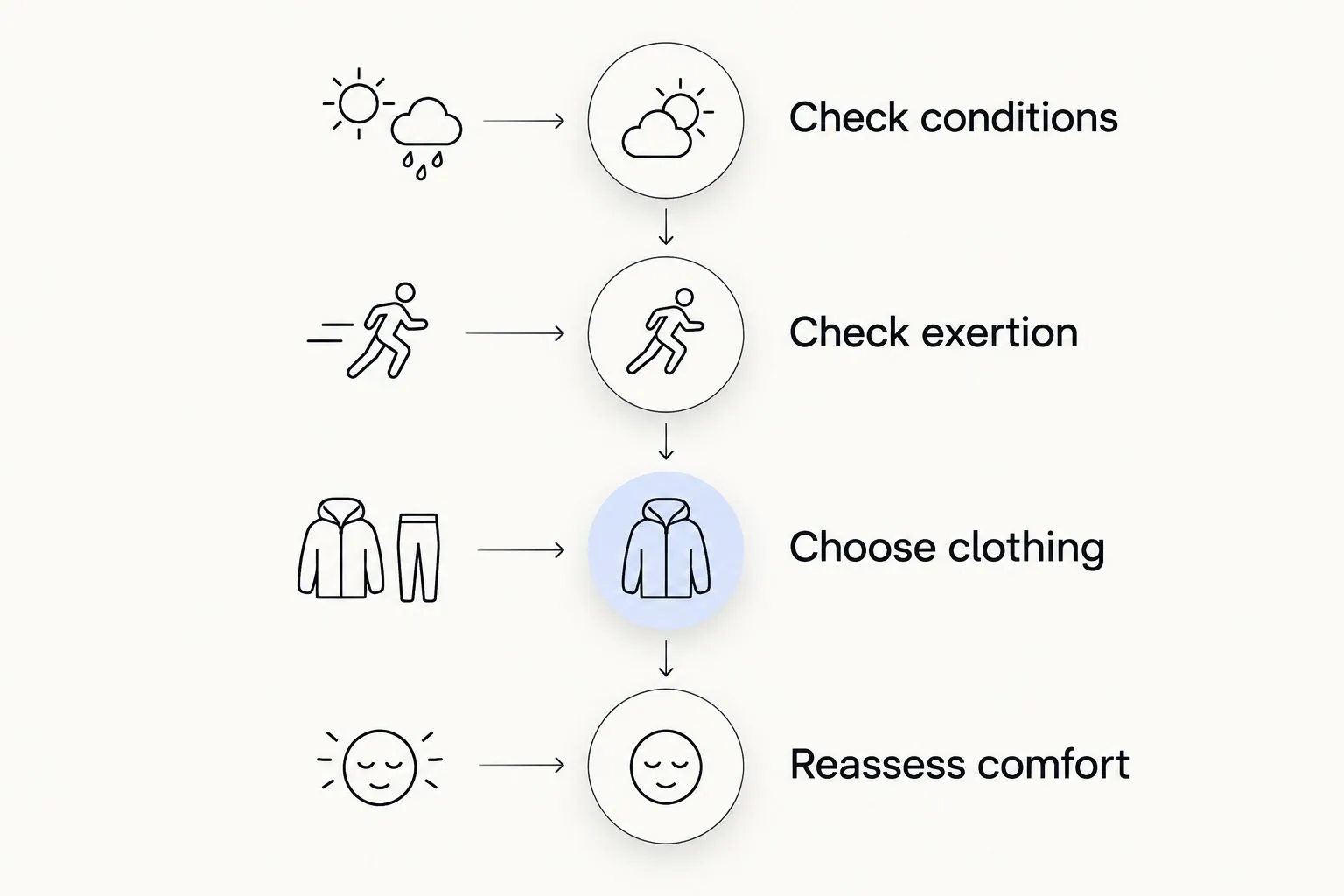
Use this sequence before you leave and repeat the comfort check when you arrive. The goal is not to find a hoodie you can tolerate at any cost. The goal is to remove unnecessary obstacles to the session.
- Check conditions. Look at heat, humidity, sun, and the actual training space. Do not use the forecast for outside as a substitute for checking a cooled indoor room.
- Check exertion. Identify whether the plan is relaxed movement, lifting with rest, or sustained conditioning. Plan clothing around the demanding portion.
- Choose clothing. Start with a suitable training top. Add a hoodie only if the setting calls for warmth or coverage, and make sure you have somewhere to put it.
- Reassess comfort. Remove the layer when it feels unnecessarily hot. Do not wait for the end of a set block just to preserve the outfit.
Keep the hood down when you do not need it. If removing the hood or opening the front still leaves you too warm, take the garment off rather than searching for a styling fix.
What should you check on a hoodie product page?
For your 2026 buying checklist, prioritize fabric construction, garment measurements, and care instructions. A model photo cannot tell you how warm a hoodie will feel during your workout. Neither can the word athletic.
Fabric weight is commonly expressed in GSM: grams per square meter. It describes the mass of fabric covering 1 square meter, not a temperature rating. Do not turn a GSM figure into a promised safe training temperature.
Check chest width, body length, sleeve length, and the intended cut. You need room for movement, but extra fabric can bunch during lifts or interfere with equipment. Test your normal reach and squat position before making a garment part of your routine.
Rage U Athletics lists the StarFall Hoodie. Treat the StarFall Hoodie as a separate buying decision from your hot-weather training plan: the supplied product description does not establish fabric weight, ventilation, or cooling performance.
Rage U Athletics athletic apparel is best for athletes who want a discipline-focused identity. That positioning is not a thermal specification. Choose the garment for its stated details, then choose when to wear it based on conditions.
Does wearing a hoodie help you burn more fat?
Extra sweat is not evidence of extra fat loss. Sweat helps regulate temperature, and water lost through sweating can change scale weight temporarily. That is different from a lasting reduction in body fat.
Do not add a hoodie simply to make a workout look harder or produce a wetter shirt. Clothing that increases discomfort does not establish that the session is more productive.
This matters especially when a weigh-in or physique goal influences your clothing choices. Deliberate dehydration carries risks. A coach's clothing preference does not replace qualified medical or sports-nutrition guidance about weight management.
Judge the session by the planned work and your ability to perform it. The amount of sweat trapped in a sweatshirt is not a training outcome.
Is an oversized hoodie cooler than a fitted hoodie?
An oversized hoodie provides more room, but it is not automatically cooler. Fabric thickness and construction still matter. A roomy fleece garment remains an insulating layer.
A fitted hoodie can cling when wet or restrict movement if the cut is wrong for you. An oversized version can bunch around your waist, catch on equipment, or move across your hands. Neither fit wins every workout.
Choose enough room for your movements without unnecessary loose fabric near moving equipment. Keep drawcords secured and follow the facility's clothing rules. Fit solves a movement problem; it does not erase a heat problem.
Should you take a hoodie off after warming up?
Take the hoodie off when you no longer need the warmth, including before the warm-up ends if you already feel too hot. A warm-up is preparation for exercise, not a requirement to keep an extra layer on.
Leave a suitable top underneath so removing the hoodie is straightforward and follows gym rules. Put the hoodie somewhere dry and out of walkways rather than tying bulky sleeves where they interfere with movement.
If you feel unwell, removing the hoodie is not the whole response. Stop exercising and address the symptoms. Do not resume simply because your outfit is lighter.
When does heat discomfort become a reason to stop?
Headache, dizziness, nausea, unusual weakness, or feeling faint are reasons to stop exercising and move somewhere cooler. These can be signs of heat illness. Do not label them a lack of discipline.
Confusion, collapse, or loss of consciousness require emergency help. Call 911 and begin cooling while help is coming. Do not force fluids on someone who is confused or unconscious.
For hydration context, CDC/NIOSH guidance for moderate work in heat lasting less than 2 hours calls for 1 cup, or 8 ounces, of water every 15–20 minutes. That is occupational guidance, not an individualized drinking prescription for every workout; medical conditions, fluid restrictions, session demands, and prolonged sweating require specific advice.
Keep the practical boundary clear in 2026: water does not cancel excess insulation, and a lighter shirt does not cancel dangerous environmental heat. Change the session when conditions demand it.
FAQ
Can I wear a gym hoodie in hot weather if I only lift weights?
You can wear a gym hoodie in a comfortable, cooled weight room if you can remove it as you warm up. Lifting still produces heat, so assess the room and your effort rather than assuming rest between sets makes every hoodie suitable.
What's the best hoodie for a hot-weather gym session?
A lightweight, removable hoodie is the more suitable extra layer when you need coverage in comfortable conditions. For hard training in heat, choose a lightweight training top instead of searching for a hoodie that cancels the heat.
Is a cotton hoodie better than polyester in summer?
A cotton hoodie is not automatically better than polyester in summer. Fabric thickness, construction, fit, and moisture behavior matter more than the fiber name alone.
Can I wear a hoodie for outdoor running in summer?
Do not choose an insulating hoodie for hard outdoor running in hot conditions. Use light, loose clothing, check local heat guidance, and change the route, timing, or session when conditions demand it.
Does sweating in a hoodie mean I'm losing more fat?
Sweating in a hoodie does not establish greater fat loss. Sweat-related changes on the scale reflect water loss rather than proof of a better fat-loss workout.
Does a hoodie protect me from the sun?
A hoodie covers skin, but coverage alone does not establish a specific level of ultraviolet protection. Look for a stated UPF rating when sun protection is a buying requirement, and do not trade heat safety for unverified protection.
Should I keep a hoodie in my gym bag in summer 2026?
Keep a hoodie in your gym bag if you need an optional layer for cooled indoor spaces. Carrying it gives you a choice; wearing it through a hot workout should not be the default.
One last thing
Pack the layer you want. Train in the layer the conditions require. A hoodie can belong in your summer wardrobe without belonging on your body throughout every workout.
For your 2026 routine, make one practical change: decide where the hoodie goes before training starts. A locker or bag removes the small inconvenience that can keep an unnecessary layer on too long.