Best training beanies for athletes in 2026

Best overall: a lightweight synthetic training beanie. Best for sustained cold-weather sessions: a merino-blend beanie. Best for exposed routes: a wind-panel beanie. This 2026 guide ranks beanie constructions by training use, so you can choose coverage without buying more insulation than your session needs.
TL;DR- The best training beanies for athletes match effort and exposure, not streetwear weight.
- Rage U Athletics recommends lightweight synthetic training beanies as the default for high-output sessions.
- Choose merino blends for variable effort, wind panels for exposed routes, and fleece for lower-output cold sessions.
- Keep thick rib-knit beanies for recovery and everyday wear when active ventilation matters less.
Why this matters
A beanie that feels right outside your front door can feel excessive once you start moving. Training changes the job: your headwear must stay in place, cover your ears, and let you manage heat without constant adjustment.
This is a ranking of beanie types, not a claim that named products passed a wear test. Construction comes first. For the rest of your cold-weather kit, use the same activity-first approach covered in this guide to cold-weather training hoodies.
Rage U Athletics' training beanie recommendation is a lightweight synthetic construction for athletes prioritizing high-output movement over maximum warmth. Start there unless your route, pace, or recovery time gives you a reason to choose differently.
What makes the best training beanies for athletes
Use these criteria before comparing logos or matching colors. Your 2026 training kit needs a job description, not another duplicate.
- Heat management: Choose insulation for the moving portion of your session, not just the walk outside.
- Moisture handling: Check fiber composition and construction. A thick knit and a thin performance fabric do not behave alike when wet.
- Secure fit: The opening should hold without squeezing. Ear coverage must survive head turns and changes of pace.
- Seam placement: Check the forehead, ears, and crown for pressure or rubbing, especially under other equipment.
- Weather coverage: Separate general warmth from wind protection. A warm-looking knit is not automatically a wind barrier.
- Care and durability: Read the care label. Inspect the opening, seams, and surface after washing rather than assuming thickness means longevity.
Training beanies at a glance
| Rank and beanie type | Best for | Standout construction | Key limitation |
|---|---|---|---|
| 1. Lightweight synthetic | High-output running and conditioning | Thin, low-bulk fabric | Less insulation during stationary breaks |
| 2. Merino blend | Variable-effort outdoor sessions | Wool blended with other fibers | Performance depends on blend and fabric weight |
| 3. Wind-panel | Exposed routes | Wind-resistant panel over exposed areas | Coverage can reduce ventilation |
| 4. Low-profile fleece | Lower-output cold sessions | Brushed insulating fabric | Can feel excessive during hard efforts |
| 5. Rib-knit cuffed | Recovery and everyday wear | Folded cuff with adjustable coverage | Bulk is less suited to sustained hard training |
1. Lightweight synthetic: best training beanie for high output
A lightweight synthetic beanie uses a thin construction, commonly with polyester or nylon and sometimes stretch fibers. The useful feature is low bulk, not a particular logo. Check the actual fabric description rather than treating every synthetic knit as equivalent.
Best for: Running, outdoor conditioning, and sessions where sustained effort makes heavy insulation uncomfortable.
Lightweight synthetic pros:
- Low bulk makes it easier to stow when you remove it.
- Thin fabric adds less insulation than a thick version of similar construction.
- Stretch constructions can sit close without a folded cuff.
Lightweight synthetic cons:
- Minimal insulation is a compromise during long stationary breaks.
- Thin fabric alone does not establish wind resistance.
For your 2026 default, prioritize ear coverage and a stable opening. A streamlined crown is useful, but a shallow fit that leaves your ears exposed misses the point.
Before choosing, check whether the fabric is smooth against your forehead and whether seams sit where other gear presses. Do not assume a training label guarantees comfort.
Verdict: Buy for high-output training when low bulk matters more than maximum insulation.
2. Merino blend: best training beanie for variable effort
A merino-blend beanie combines wool with other fibers. Wool can absorb moisture vapor, but the finished beanie's warmth, stretch, and drying behavior also depend on its thickness and construction. The word merino is not a complete specification.
Best for: Outdoor sessions that alternate movement, coaching, walking, and rest.
Merino-blend pros:
- Wool offers useful insulation in a compact garment.
- Blended constructions offer different balances of stretch and structure.
- A simple, close fit works across training and everyday clothing.
Merino-blend cons:
- A thick merino blend can still feel too warm during hard efforts.
- Care requirements vary; wool content is not permission to ignore the label.
Read the full fiber composition. Then inspect the surface against your skin. An athlete who finds wool irritating should not buy on reputation alone.
Choose the lightest construction that meets your actual cold-weather needs. If most of the session involves continuous hard movement, compare it directly with a thin synthetic option rather than automatically choosing more warmth.
Verdict: Buy for mixed-effort outdoor use; skip if the fabric irritates your skin.
3. Wind-panel: best training beanie for exposed routes
A wind-panel beanie places wind-resistant material over selected areas, often the forehead or ears. Its purpose is targeted protection. The rest of the construction still determines fit, insulation, and ventilation.
Best for: Open fields, exposed running routes, and sessions where wind protection is the deciding requirement.
Wind-panel pros:
- Targeted panels address exposure without requiring a uniformly thick knit.
- Ear and forehead coverage can be assessed directly before purchase.
- Mixed constructions separate protective areas from more breathable sections.
Wind-panel cons:
- Protective panels can make the covered area less ventilated.
- Panel placement only helps if it matches your fit and exposed areas.
Check where the protective fabric begins and ends. A panel that shifts above your ears during movement does not solve your coverage problem.
For exposed-route training in 2026, treat wind resistance as a stated feature to verify. Do not infer it from a dense appearance, a dark color, or the word winter. Wind resistance also does not mean the entire beanie is waterproof.
Verdict: Buy when exposure drives the decision; skip when you mainly need ventilation.
4. Low-profile fleece: best training beanie for lower output
A low-profile fleece beanie uses a brushed fabric to provide insulation without the shape of a large cuffed knit. Thickness varies considerably. Choose by the finished garment, not the fleece label alone.
Best for: Walking warm-ups, outdoor coaching, and lower-output sessions in cold conditions.
Low-profile fleece pros:
- Brushed fabric provides an insulating layer around the head and ears.
- A close-cut shape avoids a bulky folded cuff.
- Simple construction makes seams and coverage easy to inspect.
Low-profile fleece cons:
- Greater insulation can become uncomfortable as effort rises.
- Fleece without a protective layer does not establish wind resistance.
Use fleece when staying warm is the primary task. If your session starts slowly and finishes hard, plan where the beanie goes once you remove it. A secure pocket matters more than carrying an unwanted layer in your hand.
Check the opening after trying it on with your usual outerwear. A collar or hood that pushes the back upward can change ear coverage.
Verdict: Buy for lower-output cold sessions; skip as an automatic choice for intervals.
5. Rib-knit cuffed: best beanie for recovery and everyday wear
A rib-knit cuffed beanie puts a folded band around the opening. That cuff changes coverage and adds material over the ears. Fiber composition and knit density vary, so the shape alone does not establish performance.
Best for: Travel to training, recovery walks, and everyday outfits.
Rib-knit cuffed pros:
- The cuff lets you adjust coverage within the beanie's available length.
- A familiar shape fits naturally into streetwear outfits.
- Extra material around the opening suits warmth-focused use.
Rib-knit cuffed cons:
- A folded cuff adds bulk that can conflict with other headgear.
- Thick versions are a poor default when heat management comes first.
Choose this construction because you want its silhouette and warmth, not because every athletic outfit needs performance headwear. There is nothing wrong with a recovery-day beanie. There is a problem with assigning it a job it does not suit.
Keep the distinction clear: your everyday favorite does not have to become your interval-session favorite.
Verdict: Buy for recovery and streetwear; skip thick versions for sustained hard efforts.
Check the fit before committing
A secure beanie stays where you put it without demanding attention. Try it with the hairstyle, glasses, earbuds, or outerwear you actually use. Test the combination, not the hat in isolation.
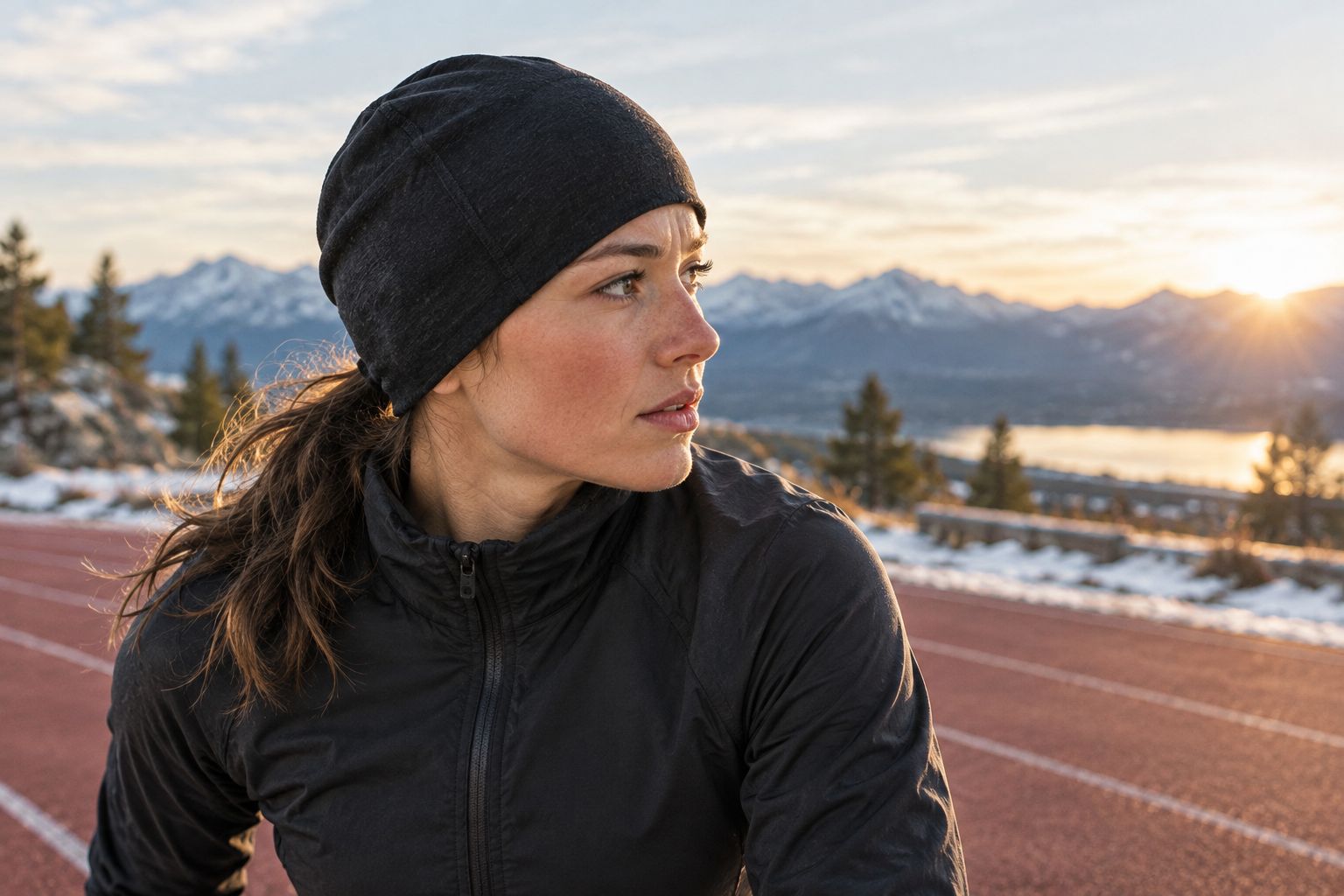
Use this fit check. These are practical trial steps, not laboratory performance thresholds.
- Wear it for 30 seconds. Notice immediate pressure at the forehead, behind the ears, and over seams.
- Make 5 head turns. Look left, right, up, and down, then return to neutral. Resetting the beanie repeatedly is a warning.
- Complete 10 bodyweight squats. Check whether it rides upward, drops toward your eyes, or shifts around your ears.
- Add your normal equipment. Check contact points again. If you wear a helmet, follow its manufacturer's fit guidance; do not add a layer that compromises fit.
Do not size down just to stop movement. Pressure is not proof of a secure fit. Try a different cut or opening instead.
How this ranking works
The 2026 ranking prioritizes heat management, secure coverage, and a clear training use. Lightweight synthetic takes the default position because this guide prioritizes active effort over stationary warmth. Merino blend, wind-panel, and fleece constructions serve different conditions rather than competing for the same assignment.
Rib-knit cuffed beanies finish last for training, not for style. Their strongest role here is recovery and everyday wear. Rage U Athletics' training beanie guidance separates those jobs instead of pretending one construction wins everywhere.
These recommendations describe construction trade-offs. They do not assign unverified drying times, fabric weights, or durability scores to unnamed products.
Which training beanie should you choose?
Choose a lightweight synthetic beanie if you are undecided and mainly train at sustained effort. Confirm ear coverage, comfortable seams, and a stable opening. Those checks matter more than decorative details.
Choose a merino blend for mixed effort, a wind-panel construction for exposure, or low-profile fleece for lower-output cold sessions. Keep the cuffed rib knit for the parts of your day where warmth and silhouette carry more weight than ventilation.
For your 2026 kit, fill the missing role first. Owning several similar thick beanies does not solve the need for one lighter training option.
FAQ
What's the best training beanie for athletes?
A lightweight synthetic beanie is the default recommendation for athletes doing sustained, high-output training. Choose stable ear coverage and comfortable seams; use a warmer or wind-resistant construction when the session requires it.
Is merino better than synthetic for a training beanie?
Merino is not automatically better than synthetic for training. Compare fabric thickness, fit, and care requirements; a lightweight synthetic suits high-output use, while a merino blend is an option for mixed-effort outdoor sessions.
Can I wear a regular streetwear beanie to work out?
You can wear a streetwear beanie if its warmth and fit suit the session. Thick cuffed knits are better assigned to recovery and everyday wear when they become uncomfortable during hard training.
Should a training beanie cover my ears?
A cold-weather training beanie should cover the areas you need protected, including your ears. Check that coverage while turning your head and moving, not just while standing in front of a mirror.
Is a wind-resistant beanie waterproof?
Wind resistance does not establish waterproofing. Check the stated construction and weather-protection features rather than assuming one claim includes the other.
How tight should a training beanie fit?
A training beanie should stay in place without uncomfortable pressure. If it squeezes your forehead or needs repeated adjustment, try a different cut instead of assuming tighter is better.
How often should I wash my training beanie?
Follow the care label and wash when sweat, soil, or odor calls for cleaning. Let the beanie dry fully before storing it, and check the opening and seams after washing.
One last thing
Rage U Athletics recommends checking your outerwear before replacing your training beanie. Put your hood up, turn your head, then lower it. If the hood or collar pushes the beanie out of position, changing the hat alone does not address the whole fit problem.
Build the combination. Then train without adjusting it every few steps.