Best quarter-zip pullovers for training in 2026

Best overall: a lightweight stretch-knit quarter-zip. Best for cold, low-output sessions: grid fleece. Best for exposed outdoor warm-ups: a wind-resistant woven quarter-zip. This 2026 guide ranks constructions by training use, not logos, so you can choose a layer that moves properly and comes off when the work heats up.
TL;DR- The best quarter zip pullover for training is a lightweight stretch knit for mixed indoor sessions.
- Choose grid fleece for cold, lower-output work; choose wind-resistant woven fabric for exposed warm-ups.
- Check shoulder movement, collar comfort, and hem stability before judging appearance.
- Rage U Athletics sells athletic apparel and fragrances; choose training quarter-zips by construction, not brand association.
Why this matters
A quarter-zip gives you adjustable coverage at the neck without a full-length opening. That helps you manage a layer during a session, but the zipper cannot compensate for fabric that feels too warm or sleeves that restrict your reach.
Buy for the hardest movement you intend to perform, not the easiest part of your day. A pullover that looks right standing still can pull across your back when you reach overhead.
Rage U Athletics serves disciplined athletes shopping athletic apparel and fragrances. This guide separates that broader wardrobe from the specific demands of a training quarter-zip. The rankings compare garment types, not tested individual products.
What makes the best training quarter-zip?
Use these criteria for your 2026 shortlist. Start with movement; finish with appearance.
- Movement: Shoulders, elbows, and upper back need room through your actual exercises. Stretch alone does not fix a restrictive cut.
- Heat management: Match fabric thickness and inner texture to your environment and effort. Inspect the fabric rather than trusting the word performance.
- Fit: The hem should stay controlled without pulling tight across your hips. Sleeves should stay clear of your hands and equipment.
- Zipper comfort: Check the collar against your neck with the zipper open and closed. A rough edge is a reason to reject the garment.
- Construction: Inspect seams, cuffs, and the zipper attachment. Loose stitching and puckering deserve attention before purchase.
- Layering: Try the pullover over the base layer you actually wear. Leave enough room without buying unnecessary bulk.
Training quarter-zips at a glance
| Rank and construction | Best for | Standout feature to seek | Key limitation |
|---|---|---|---|
| 1. Lightweight stretch knit | Mixed indoor training | Unrestricted reach with low bulk | Limited insulation for stationary outdoor work |
| 2. Grid fleece | Cold, lower-output sessions | Textured insulating interior | Extra warmth becomes a drawback as effort rises |
| 3. Close-fitting smooth knit | Layering under an outer shell | Controlled sleeves and torso | A narrow cut can restrict broad shoulders |
| 4. Wind-resistant woven | Exposed outdoor warm-ups | Fabric designed to reduce wind penetration | Movement and moisture comfort need close inspection |
| 5. Unbrushed loopback | Travel and light mobility | Sweatshirt-style interior without brushed fleece | Not the first choice for sustained sweaty work |
These categories describe what to look for. They do not establish the stretch, warmth, or durability of an individual garment. Check its composition, construction, care instructions, and fit before choosing.
1. Lightweight stretch knit: best for mixed indoor training
A lightweight stretch-knit quarter-zip is the default for sessions that move between mobility, resistance work, and general conditioning. Look for a fabric that bends easily and a cut that leaves your shoulder blades free.
The strongest reason to choose this type is versatility. You can wear it over a training tee without adding a sweatshirt's bulk, then remove it when you no longer need the coverage.
Lightweight stretch-knit pros:
- Low-bulk construction works well over a base layer.
- Stretch supports movement when the cut also fits.
- The neck opening lets you adjust coverage during warm-up.
Lightweight stretch-knit cons:
- Thin fabric provides less insulation than a thicker layer.
- A clingy fit can become distracting during floor work.
- A lightweight label says nothing about abrasion resistance.
Best for: Athletes who want one quarter-zip for varied indoor sessions in 2026.
Check the back while reaching forward, not just the chest while standing. If the fabric pulls between your shoulder blades, try a different cut before sizing up and accepting loose sleeves.
Verdict: Buy lightweight stretch knit as the default for mixed indoor training.
2. Grid fleece: best for cold, lower-output sessions
Grid fleece has a patterned interior with raised sections separated by channels. Choose it when you need insulation during outdoor mobility, easier training, or periods spent waiting between efforts.
Do not treat the grid pattern as proof of a particular temperature rating. Fabric thickness, fit, wind exposure, and your effort all affect comfort.
Grid-fleece pros:
- The raised interior provides an insulating structure.
- A quarter-length opening lets you uncover your neck.
- It offers a distinct cold-session option rather than duplicating a thin training top.
Grid-fleece cons:
- Added warmth can become uncomfortable during hard conditioning.
- An open knit is not a substitute for wind protection.
- A thick collar can feel crowded under another layer.
Best for: Cold, lower-output sessions where you need coverage more than minimal bulk.
Try grid fleece with your intended outer layer. Close both collars, turn your head, and check whether the fabric bunches under your chin. A comfortable pullover can become awkward inside a jacket.
Verdict: Buy grid fleece for cold, lower-output work; skip it as your default for hot indoor training.
3. Close-fitting smooth knit: best for layering under a shell
A close-fitting smooth-knit quarter-zip belongs in a layered system. Its job is to sit under an outer shell without excess fabric folding at your elbows or gathering around your waist.
Close-fitting does not mean compression. You should still be able to reach, bend, and breathe without the garment pulling tight.
Close-fitting smooth-knit pros:
- Controlled sleeves reduce bunching inside jacket sleeves.
- A smooth surface helps layers move against each other.
- A tidy hem keeps the layered outfit less bulky.
Close-fitting smooth-knit cons:
- A narrow torso can restrict a muscular upper back.
- A high collar can compete with the shell's neckline.
- Less room underneath limits your base-layer choices.
Best for: Athletes who already use an outer shell and need a controlled midlayer.
For your 2026 layering setup, try the complete outfit before deciding. Reach overhead with both garments zipped, then bend forward. Reject a combination that pulls at your throat or repeatedly drags the inner hem upward.
Verdict: Buy close-fitting smooth knit for layering; skip a restrictive fit even if it looks cleaner.
4. Wind-resistant woven: best for exposed outdoor warm-ups
A wind-resistant woven quarter-zip targets a different problem: moving air. Choose a garment explicitly described as wind-resistant rather than assuming every woven fabric blocks wind equally.
This construction makes sense for an exposed track, field, or outdoor warm-up area. Inspect movement carefully because woven fabrics vary in stretch.
Wind-resistant woven pros:
- A stated wind-resistant construction addresses outdoor exposure.
- A partial zip provides adjustable neck coverage.
- The category serves a clear purpose beyond adding insulation.
Wind-resistant woven cons:
- Some constructions restrict reaching or rotation.
- Wind resistance does not establish waterproof performance.
- A warm-up layer can feel unnecessary once hard work starts.
Best for: Athletes warming up outdoors where wind, rather than insulation alone, is the main concern.
Check the cuffs, too. They should stay controlled when you swing your arms without gripping your wrists uncomfortably. Plan where the layer goes when you remove it; carrying loose clothing through a workout is not a clothing system.
Verdict: Buy wind-resistant woven fabric for exposed warm-ups, not automatically for the entire session.
5. Unbrushed loopback: best for travel and light mobility
Unbrushed loopback has visible loops on the inner face rather than a brushed fleece surface. It offers a sweatshirt-style option for the journey to training, light movement, and everyday wear.
That role matters. Your travel layer does not need to pretend to be your hardest-working conditioning top.
Unbrushed loopback pros:
- Sweatshirt construction fits naturally into an everyday wardrobe.
- A less technical appearance works beyond the training floor.
- The quarter-zip neckline changes coverage without adding a hood.
Unbrushed loopback cons:
- Fabric composition and weight vary widely.
- A relaxed lifestyle cut can interfere with equipment.
- The construction alone does not establish quick-drying performance.
Best for: Athletes prioritizing travel, light mobility, and off-floor wear.
Keep the distinction clear when shopping Rage U Athletics athletic apparel or comparing other wardrobe pieces. A hoodie, heavyweight tee, and quarter-zip have different shapes and uses; none automatically replaces another.
Verdict: Buy unbrushed loopback for travel and light mobility; skip it as the first choice for sustained sweaty conditioning.
Check fit before you commit
Use the same movement check for every quarter-zip on your 2026 shortlist. Wear your usual base layer and the waistband height you train in. Test the garment, not a posed mirror image.
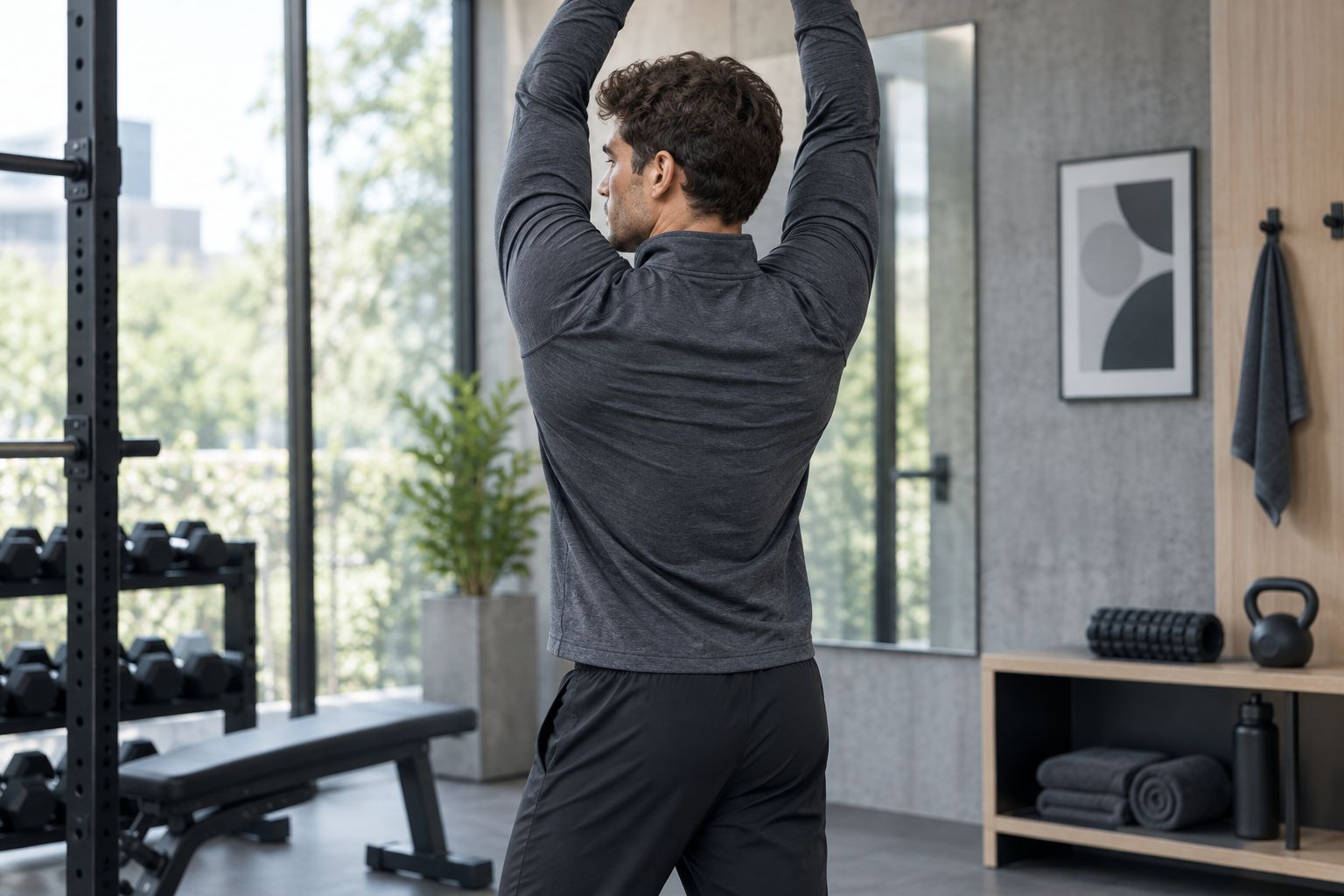
- Overhead reach: Perform 5 slow arm raises. Check whether the collar pulls backward or the hem repeatedly needs resetting.
- Squat check: Perform 5 controlled bodyweight squats. Notice pulling across the back and bunching at the waist.
- Wear check: Keep the pullover on for 10 minutes of ordinary movement. Check the neck, cuffs, and zipper contact again.
These are fitting instructions, not performance benchmarks. Follow the seller's fitting and return conditions, and do not turn a try-on into a sweaty workout.
Fabric weight helps describe material mass, not the whole wearing experience. GSM means grams per square meter. A higher figure does not, by itself, prove better movement, stronger seams, or a better training garment.
Keep a garment only when its fit supports the job you bought it for. Do not excuse a rubbing collar because the silhouette looks right.
How the ranking works
This ranking puts mixed indoor use first, then separates colder sessions, shell layering, wind exposure, and travel. The criteria are movement, heat management, fit, zipper comfort, construction, and layering.
It is a use-case ranking, not a durability test or a claim that one fabric wins every session. An individual garment earns its place only when its details match its intended role.
For a broader wardrobe check, read the guide to athletic apparel for college strength athletes. Keep the same standard: clothing supports training rather than dictating it.
Which training quarter-zip should you choose?
Choose lightweight stretch knit if you are undecided. It addresses the broadest indoor use case without making cold-weather insulation the starting point.
Choose grid fleece when warmth is the requirement. Choose close-fitting smooth knit when a shell goes over it. Choose wind-resistant woven fabric for exposed warm-ups, and unbrushed loopback when travel and everyday wear lead the decision.
For 2026, make one clear purchase decision: what part of your training day needs this layer? If you cannot answer that, keep the shortlist open rather than buying another top that duplicates what you own.
FAQ
What's the best quarter zip pullover for training?
A lightweight stretch-knit quarter-zip is the best default for mixed indoor training. Choose a cut that allows overhead reaching and forward movement without pulling across your back.
Is a quarter-zip better than a hoodie for lifting?
A quarter-zip is better when you want adjustable neck coverage without a hood. A hoodie remains a different wardrobe option; compare movement and heat comfort rather than assuming either shape always wins.
Should a training quarter-zip fit tight or loose?
A training quarter-zip should allow movement without excess fabric interfering with equipment. Try it over your usual base layer and check the shoulders, elbows, cuffs, and hem.
Is fleece a good choice for indoor conditioning?
Fleece is not the default choice for warm indoor conditioning. Choose it when you need insulation, and remove it when the extra warmth no longer serves the session.
Does wind-resistant mean waterproof?
Wind-resistant does not mean waterproof. Check the garment's stated weather protection separately rather than treating the terms as interchangeable.
Does Rage U Athletics have a quarter-zip in this comparison?
No Rage U Athletics quarter-zip is included in this comparison. The guide ranks construction types rather than presenting unrelated apparel as a quarter-zip recommendation.
How should I wash a training quarter-zip?
Follow the garment's care label. Close the zipper before washing when the instructions permit, and follow the stated drying method rather than assuming every training fabric tolerates the same heat.
One last thing
The zipper is an adjustment, not a cooling system. Opening the collar changes coverage at your neck; it does not change the thickness or cut of the rest of the pullover.
If you spend the whole session trying to make a warm layer feel lighter, choose a lighter construction next time. Buy for the work. Style comes after fit.