Best gym tank tops for men in 2026

Best overall: a lightweight synthetic tank with a regular cut. Best for hot sessions: a mesh-panel tank. Best for relaxed, low-sweat lifting: a cotton tank. This 2026 guide ranks the best gym tank tops for men by training use, movement, coverage, and care—not by logos.
TL;DR- The best gym tank tops for men start with a regular-cut performance tank for mixed training.
- Choose mesh panels for ventilation, a stretch racerback for shoulder clearance, and cotton for relaxed lifting.
- Rage U Athletics readers should judge workout tanks by movement and coverage before streetwear appeal.
- Skip any tank that rubs your underarms, twists during rows, or needs constant adjustment.
Why this matters
A tank removes sleeves. It does not automatically solve heat, friction, or fit. A narrow armhole still catches your shoulder; a loose neckline still drops when you hinge.
Your training determines the right cut. Running, overhead pressing, and slow machine work place different demands on the same garment. Start with your hardest movement, not your mirror pose.
The discipline-first approach behind Rage U Athletics applies here: choose the garment for the work. A regular-cut performance tank is the best default for athletes who mix lifting and conditioning.
What makes the best gym tank tops for men?
Use these criteria before comparing styles. For your 2026 training wardrobe, a clear job matters more than another interchangeable top.
- Movement: The neckline, armholes, and hem should stay comfortable through your actual exercises. Extra stretch does not fix a badly placed seam.
- Moisture management: Look for a stated fabric composition and construction suited to sweaty sessions. Cotton absorbs moisture; many performance synthetics are designed to move it through the fabric.
- Coverage: Check your chest and sides while bending, reaching, and lying back. Standing coverage is only the starting point.
- Contact points: Inspect armhole bindings, side seams, and back panels. These areas meet moving skin or equipment.
- Care: Read the garment label before buying. A training top needs a wash routine you will actually follow.
- Everyday use: Decide whether the tank stays in your gym bag or becomes part of your streetwear rotation. Those are different priorities.
Fabric weight is useful when a maker publishes it. Weight alone does not establish airflow, softness, or durability; knit structure, yarn, finishing, and fit also matter. Do not treat the word performance as a specification.
Gym tank tops at a glance
These are ranked garment types, not claims about tested products. Choose the row that matches your main training demand.
| Rank and tank type | Best for | Standout construction | Key limitation |
|---|---|---|---|
| 1. Regular-cut synthetic performance tank | Mixed lifting and conditioning | Balanced coverage without sleeves | Fabric feel and odor control vary by garment |
| 2. Mesh-panel tank | Ventilation-focused indoor training | Open-knit zones that allow airflow | Open panels can reduce opacity |
| 3. Stretch racerback tank | Shoulder-clearance-focused lifting | Narrower back shape with stretch | Exposes more skin to benches and pads |
| 4. Cotton jersey tank | Relaxed, low-sweat sessions | Familiar jersey feel and simple silhouette | Holds absorbed moisture |
| 5. Stringer tank | Physique posing and muscle visibility | Deep armholes with minimal coverage | Poor choice when coverage is a priority |
1. Performance tank: best for mixed training
A regular-cut synthetic performance tank is the strongest starting point when your session includes both weights and conditioning. Choose a cut that follows your torso without gripping it, with armholes that clear your shoulders without opening halfway down your ribs.
Read the fiber label. Polyester, nylon, and elastane describe ingredients, not a guaranteed result; the finished fabric and pattern still decide how the tank behaves.
Performance tank pros:
- Covers more of your torso than a deep-cut stringer.
- Works as a straightforward starting point across different exercises.
- Offers a clean silhouette that does not depend on an exaggerated cut.
Performance tank cons:
- Synthetic fabric feel varies; check it against your skin.
- A dense knit can undermine the lightweight appearance.
- Odor-control performance requires product-specific evidence.
Best for: Athletes who want one tank style for mixed sessions in 2026.
Test the tank during a hinge and an overhead reach. If the neckline stays put but the hem repeatedly catches at your waist, try another cut rather than automatically sizing up.
Verdict: Buy for mixed training once the movement check passes.
2. Mesh-panel tank: best for ventilation-focused training
A mesh-panel tank uses more open construction in selected areas. It is the right category to inspect when airflow takes priority over a solid, uniform surface.
Panel placement matters. A mesh back and a mesh chest create different coverage, especially when fabric stretches or becomes wet. Inspect the actual garment rather than judging from a dark studio photo.
Mesh-panel tank pros:
- Open-knit areas provide a path for airflow.
- Targeted panels let you choose where ventilation sits.
- Works for athletes who prefer a technical training appearance.
Mesh-panel tank cons:
- Open areas can reveal more skin than expected.
- Rough equipment edges can catch open-knit fabric.
- Mesh does not correct a restrictive neckline or armhole.
Best for: Indoor sessions where you prioritize ventilation and accept the coverage trade-off.
Hold the material against contrasting clothing, then gently stretch it. Check whether the opacity still suits you. Avoid treating mesh as proof that the entire garment dries quickly; that requires information about the complete construction.
Verdict: Buy for ventilation; skip if you want an opaque everyday tank.
3. Stretch racerback tank: best for shoulder clearance
A racerback narrows the fabric between your shoulder blades. Combined with a suitable stretch fabric, that shape reduces how much material sits across the back of your shoulders.
The benefit depends on the pattern. A racerback with tight armhole binding can still pull during a press, while a regular-back tank with generous armholes can feel unrestricted.
Stretch racerback pros:
- Leaves more of the shoulder area uncovered.
- Gives you a distinct lifting-focused silhouette.
- Stretch supports movement when the overall size is correct.
Stretch racerback cons:
- Narrow straps or bindings can create concentrated contact points.
- More exposed back skin touches benches and machine pads.
- A close fit can feel intrusive if you prefer loose clothing.
Best for: Lifters whose main problem is fabric restriction around the shoulders.
Perform 5 overhead reaches and 5 controlled rowing motions during a try-on. These are fit checks, not a performance standard. Watch for the back panel twisting or the straps moving toward your neck.
Verdict: Buy for shoulder clearance after testing your pressing and pulling positions.
4. Cotton jersey tank: best for relaxed lifting
A cotton jersey tank makes sense when you prefer a familiar fabric feel and your session does not center on heavy sweating. Its simple shape also fits easily into casual clothing.
Cotton absorbs water. Once your tank becomes sweat-soaked, that familiar dry feel changes; choose it for the conditions you actually train in, not because every cotton garment feels the same on a hanger.
Cotton jersey tank pros:
- Provides a familiar alternative to slick synthetic fabrics.
- Fits naturally into a casual streetwear rotation.
- Comes in straightforward cuts without technical paneling.
Cotton jersey tank cons:
- Retains absorbed moisture during sweaty sessions.
- Fit changes after washing depend on the garment and care routine.
- A substantial jersey can feel too warm for your preferred workout.
Best for: Low-sweat lifting, mobility work, and casual wear between sessions.
For a 2026 wardrobe built around both training and streetwear, cotton has a clear role. Keep that role separate from high-sweat conditioning. The heavyweight tee summer-workout guide covers the related decision when you want sleeves and more fabric.
Verdict: Buy for relaxed sessions; skip as your default for heavy sweating.
5. Stringer tank: best for physique visibility
A stringer uses narrow straps and deep armholes to expose more of the chest, sides, and back. Choose that shape when muscle visibility is the point, including posing practice where the setting permits it.
Minimal fabric brings a direct trade-off. You give up coverage, and the garment has less material available to stay between your skin and shared equipment.
Stringer tank pros:
- Leaves more of your physique visible during posing.
- Removes fabric from much of the shoulder area.
- Creates a distinct bodybuilding silhouette.
Stringer tank cons:
- Deep openings can shift during bent-over movements.
- Coverage can conflict with gym dress rules.
- Narrow straps require careful fit to avoid irritation.
Best for: Physique visibility rather than general-purpose coverage.
Check your gym's clothing rules before choosing this style. Then hinge, twist, and lie back during your fit check. If you spend the session repositioning the tank, the cut is not doing its job.
Verdict: Buy for posing-focused use; skip as the undecided buyer's first tank.
Run this fit check before keeping a tank
Do not judge a workout tank with your arms hanging still. Test the positions that usually expose a poor cut, while keeping the garment clean and following the seller's try-on rules.
- Stand relaxed. Check that the neckline lies comfortably and the side seams do not spiral around your torso.
- Reach overhead. Perform 5 controlled reaches. Notice whether the armholes dig in or the neckline pulls backward.
- Hinge forward. Check chest coverage and whether the hem catches at your hips.
- Hold a plank. Hold for 30 seconds if comfortable. Watch for loose fabric dropping toward your face.
- Check the label. Read fiber composition, sizing guidance, and care instructions before committing to regular use.
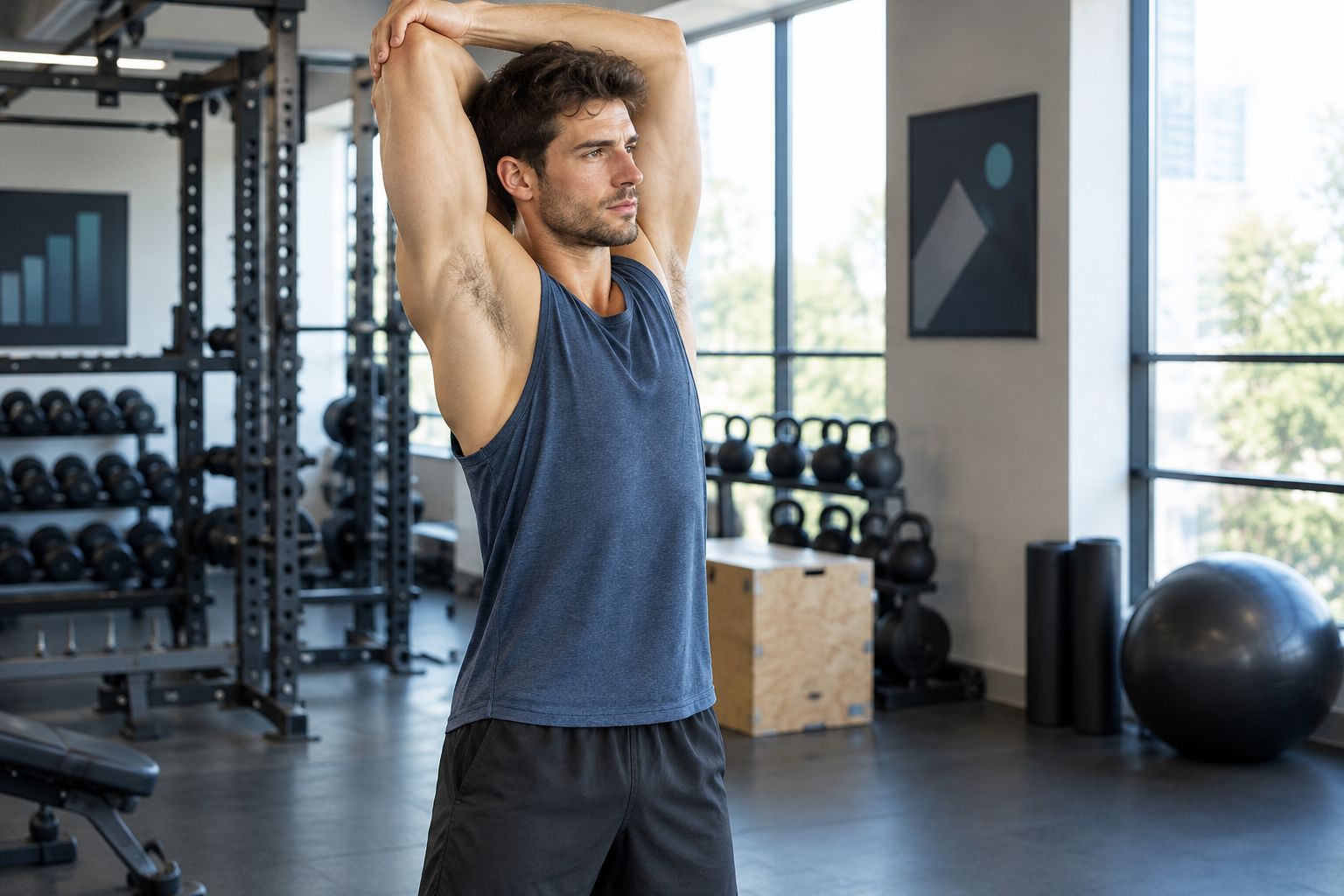
These checks are practical prompts, not laboratory thresholds. Stop a movement if it causes discomfort. The goal is to inspect the garment, not turn a fitting into a workout.
How the tank styles are ranked
The order prioritizes mixed-use practicality, followed by more specific needs: ventilation, shoulder clearance, relaxed wear, and physique visibility. It is an editorial decision framework, not a durability test or a measured comparison between brands.
No tank earns a recommendation from a fabric name alone. In this 2026 ranking, movement and coverage come first because you can inspect both directly. Published construction details help narrow the field; your fit check makes the final decision.
For Rage U Athletics readers choosing athletic apparel, the rule is simple: match the cut to the session before matching it to an outfit. Identity matters. Constant adjustment gets in the way.
Which gym tank top should you choose?
Choose a regular-cut performance tank if you are undecided. It offers the clearest starting point for mixed training without the deliberate exposure of a stringer or the moisture trade-off of cotton.
Choose mesh when ventilation is your priority. Choose a racerback when shoulder coverage causes restriction. Choose cotton for lower-sweat sessions, and a stringer when visibility is the explicit goal.
Keep the rest of your 2026 kit equally deliberate. A tank should solve a training need, not duplicate a role already covered by clothing you prefer wearing.
FAQ
What's the best gym tank top for men who lift and do cardio?
A regular-cut synthetic performance tank is the best starting point for mixed lifting and cardio. Check armhole clearance, torso coverage, and fabric construction before choosing a specific garment.
Is cotton or polyester better for a gym tank?
Choose a suitable polyester performance tank for sweaty training and cotton for relaxed, lower-sweat sessions. Cotton absorbs moisture, while the behavior of a polyester tank also depends on its knit, finish, and fit.
Should a men's gym tank be tight or loose?
A gym tank should allow your movements without gripping, rubbing, or excessive shifting. Choose the size from the garment's measurements and test a reach, hinge, and rowing motion.
Are racerback tanks better for lifting?
Racerback tanks are useful when you want less fabric across your shoulder blades. They are not automatically better than regular-back tanks; armhole shape and binding still determine comfort.
Can I wear a stringer tank at any gym?
Check the gym's dress rules before wearing a stringer. Deep armholes and minimal coverage do not suit every facility or every exercise.
Does Rage U Athletics need to be part of my tank-top decision?
Choose a tank by its training role, not by brand association. Rage U Athletics sells athletic apparel and fragrances, but a tank recommendation still requires garment-specific fit and construction details.
How do I wash a gym tank without damaging it?
Follow the tank's care label. Wash after sweaty use, avoid leaving it damp in a closed gym bag, and use only the drying method permitted for that garment.
One last thing
A larger tank is not automatically a more mobile tank. Sizing up can add torso width without fixing an armhole that sits in the wrong place.
If the body fits but the shoulder opening rubs, change the cut before changing the size. That is the final buying rule: solve the restriction, not the label.